Hajra Naz
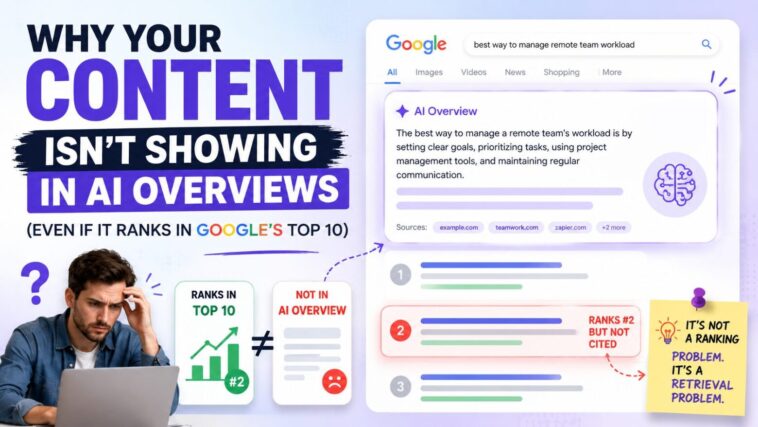
Content can rank in Google’s top 10 and still miss out on traffic because AI Overviews increasingly answer the query directly on the results page — getting cited inside those AI answers now requires clear, extractable, well-structured content, not just strong rankings.
For years, SEO followed a simple rule. Rank higher, get more traffic.

If your page reached Google’s top 10 results, you were in a strong position to attract clicks and grow your audience. But Google’s AI Overviews have changed that formula.
Today, you can hold the second or third organic position and still never appear inside the AI-generated answer at the top of the search results. Meanwhile, another website ranking much lower—or sometimes not even on the first page—can become Google’s preferred source.
That’s frustrating for many publishers. They’ve invested months creating detailed content, improving page speed, building backlinks, and optimizing every SEO factor. Yet Google chooses someone else’s article for its AI Overview.
The reason is simple.
Ranking and retrieval are no longer the same thing.
Traditional search rankings and AI overviews use different evaluation methods. A ranking tells Google that your page deserves a place in the search results. AI Overviews decide whether your content is the best answer to extract and present to users.
Understanding that difference is becoming one of the most important skills in modern SEO.
Read More: Why Simple SEO Tactics Won’t Work for lasting AI search visibility
Why Rankings No Longer Guarantee AI Overview Visibility
Google’s AI Overviews don’t simply copy information from the highest-ranking pages.
Instead, Google’s AI looks across multiple sources and searches for content that answers a question clearly and accurately, with sufficient supporting evidence.
Think about how people use AI.
When someone asks ChatGPT or Gemini a question, they expect an immediate answer. They don’t want to read five paragraphs before getting to the point.
Google’s AI works similarly.
Its retrieval system searches for information it can easily understand and confidently quote.
That means a page ranking in Position 8 could appear in the AI Overview while Position 2 gets ignored completely.
This is one of the biggest shifts SEO has experienced in years.
The Ranking-Citation Gap Is Growing
Recent research from BrightEdge shows that the overlap between Google’s organic rankings and AI Overview citations has increased over time.
In May 2024, only about one-third of AI Overview citations came from pages already ranking highly in organic search.
By September 2025, that overlap had grown to around 54%.
At first glance, that sounds like good news.
But it also means nearly half of AI Overview citations still come from pages that aren’t among the highest-ranking organic results.
In other words, Google is willing to ignore better-ranked pages if another article provides a cleaner or more useful answer.
The pattern also changes depending on the industry.
Healthcare, insurance, finance, and education tend to have stronger overlap because Google relies on highly trusted sources in these sensitive areas.
Meanwhile, e-commerce websites often see much less overlap between rankings and AI citations.
The takeaway is clear.
A top ranking improves your chances, but it doesn’t guarantee visibility inside AI Overviews.
Read More: Google is testing to combine AI Overviews with AI Mode
5 Reasons Google Skips Your Content
If your article isn’t appearing in AI Overviews, there’s usually a reason.
Here are the most common problems.
1. Your Content Answers the Wrong Question
Many SEO articles target keywords instead of user intent.
For example, you might optimize for the keyword “project management software.”
But someone searching Google may actually ask,
“What’s the best way to manage remote employees?”
Those are two different questions.
One focuses on software. The other focuses on solving a workplace problem.
Google’s AI usually prefers content that directly answers the user’s real question instead of pages optimized around broad commercial keywords.
Before writing, ask yourself:
What problem is the searcher actually trying to solve?
If your page doesn’t answer that question immediately, AI may ignore it.
2. Your Answer Appears Too Late
This is one of the biggest mistakes content creators make. Many articles begin with lengthy introductions. They explain the history of a topic. They define basic concepts. They repeat the keyword several times.
Only after several paragraphs do they answer the question. Traditional readers might tolerate that. AI retrieval systems usually won’t.
Google prefers pages that deliver the answer within the opening section.
Imagine someone searches:
“How often should you water tomato plants?”
A weak introduction might spend 300 words discussing gardening before answering.
A stronger article starts like this:
“Tomato plants usually need watering two to three times per week, depending on temperature, soil type, and rainfall.”
That’s exactly the kind of answer AI systems can extract.
3. Your Article Is Difficult to Scan
Long-form content still works. But it needs structure.
Many websites publish 4,000-word guides with very few headings and enormous paragraphs. Readers struggle with that. AI struggles too.
Google’s retrieval system prefers content divided into clear sections. Each heading should answer one specific question. Each section should make sense on its own.
Think of every heading as a mini article.
That makes it easier for Google’s AI to understand your content and pull relevant information.
Simple formatting also helps.
Use:
- Descriptive headings
- Short paragraphs
- Bullet points
- Tables where appropriate
- Numbered steps
These elements improve readability for both humans and machines.
4. Your Content Doesn’t Demonstrate Expertise
Google continues emphasizing E-E-A-T:
- Experience
- Expertise
- Authoritativeness
- Trustworthiness
These signals matter even more for AI-generated answers.
Many websites assume domain authority alone is enough.
It isn’t.
Each article should prove its credibility.
Ask yourself:
- Does the article include original research?
- Are statistics linked to trusted sources?
- Does the author have relevant experience?
- Have you included expert opinions?
- Are examples based on real-world knowledge?
Articles written entirely from publicly available information often look identical.
Google wants something more valuable.
First-hand experience, original insights, and expert analysis help your content stand out.
5. Your Keywords Don’t Trigger AI Overviews
Sometimes your content isn’t the problem. The search query is.
Not every Google search produces an AI Overview.
Informational searches are the most likely.
Examples include:
- How does cloud computing work?
- What is technical SEO?
- Why is protein important?
Transactional searches usually behave differently.
Queries like:
- Buy iPhone 17
- Nike running shoes
- Cheap flights to Dubai
often display shopping results instead.
Before optimizing for AI overviews, search your target keyword yourself.
If Google isn’t showing an AI Overview, there’s nothing to optimize for.
Read More: How to Get Traffic When AI Overviews Answers Everything
AI Overviews Are Changing Click Behavior
The biggest impact isn’t rankings. It’s traffic.
Studies show users behave differently when AI overviews appear. Many people read Google’s AI-generated summary and never click on another website.
That means publishers lose traffic even when their rankings stay the same. However, another trend is emerging.
Websites that are cited inside AI Overviews often receive more attention than those appearing only in traditional search results.
Being featured inside the AI answer increases visibility and builds trust.
Instead of competing for Position 1, many publishers are now competing for a citation inside Google’s AI response.
How to Optimize for AI Retrieval
Fortunately, there are practical ways to improve your chances.
Answer the Main Question Immediately
Don’t make readers hunt for the answer. Give it within the first 100 words. You can expand later.
Write Clear Headings
Avoid vague headings like the following:
Benefits
Instead, write:
What Are the Benefits of Content Clustering?
Questions help both readers and AI systems.
Break Up Long Sections
Large blocks of text discourage readers. Use shorter paragraphs. Mix in lists, examples, and subheadings. Good formatting improves extraction.
Add Original Value
Don’t simply rewrite what’s already ranking.
Include:
- Personal experience
- Case studies
- Screenshots
- Original data
- Expert quotes
- Real examples
Unique content is harder to replace.
Cover Related Questions
Google prefers websites demonstrating topical authority.
Instead of answering one question, answer several related ones.
For example, an article about AI overviews might also explain the following:
- How AI citations work
- What triggers AI Overviews
- Common optimization mistakes
- Best content formats
- Future SEO trends
Comprehensive coverage increases your authority.
The Future of SEO Is Retrieval Optimization
SEO isn’t disappearing. It’s evolving.
Traditional ranking signals like backlinks, page speed, and keyword optimization still matter. But they’re no longer enough on their own. Google now asks a second question after ranking your page:
“Can I confidently use this content to answer the user’s question?”
If the answer is no, your page may never appear in an AI Overview, even if it ranks above competitors.
That means content creators need to think differently. Instead of writing only for search engines, write for retrieval systems.
- Create articles that answer questions quickly.
- Use a clear structure.
- Show genuine expertise.
- Support your claims with reliable evidence.
Most importantly, make every section valuable enough to stand on its own.
Read More: Google Will Extend Ads in AI Overviews Worldwide
Final Thoughts
Within the industry consensus of the traditional Google SEO sector, ranking among the top 10 results on Google Search remains the core performance outcome, as it brings a web page exposure, authority, and organic traffic. However,
In the new environment brought about by the widespread adoption of Google AI Overview, search ranking is only one factor in SEO success. Google now favors useful content that is easy to
understand and extractable. Content that consistently answers questions clearly, demonstrates genuine professional credibility, and is structured in its presentation will see a significantly higher chance of being cited in AI overviews. In the future,
The core of SEO will not only be to be found by users but also to become a credible source that Google can cite.
Frequently Asked Questions
Why doesn’t my top-ranking content show up in AI Overviews?
Ranking well and being cited by AI Overviews are different things — AI systems favor content with clear, direct answers near the top of the page, FAQ formatting, and strong authority signals.
How can I get my content cited in AI Overviews?
Add a direct, concise answer early in the page, use FAQ sections with real questions and answers, and strengthen author/expertise signals — these are what AI systems pull from most often.
Related reading
Last updated: August 2026.