Hajra Naz
AI-generated posts, images, and videos are flooding social media feeds fast enough that many users now sense something is “off,” raising real concerns about feed quality, trust, and authenticity across platforms.
Something strange is happening to your feed, and you’ve probably already noticed it — even if you couldn’t quite name what felt off.

AI can now knock out a post, an image, a video, or even a fake conversation in the time it takes you to read this sentence. That speed is exactly the problem. Writing used to take effort, and effort used to be a rough filter for quality. Now that filter is gone, and platforms are drowning in content nobody really “made” in the old sense of the word.
The question everyone’s asking, in one form or another: can you still trust what you’re looking at?
LinkedIn Is Seeing the Most AI-Generated Content
Turns out the platform full of humble-brags and “I’m thrilled to announce” posts has a new problem — and it’s LinkedIn leading the pack.
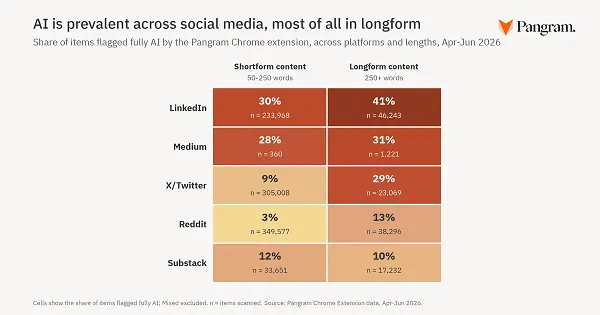
A detection company called Pangram, which built a browser extension for spotting AI writing, put a number on it: roughly 41% of long-form LinkedIn posts look machine-generated. That’s a big chunk of a feed people go to for supposedly genuine professional insight.
Worth a grain of salt here — no AI detector nails it every time, and Pangram’s own numbers are estimates, not gospel. Still, even as a rough estimate, it’s a lot.
X came in second. Pangram’s data put nearly a third of its long-form posts in the “probably AI” bucket too.
Every Social Platform Is Facing the Same Challenge
It’s not just LinkedIn and X — this is showing up everywhere.
Pinterest users have been complaining for a while now that their boards are quietly filling up with AI-generated images instead of the real photography and art they signed up for. Pinterest actually responded to this, rolling out a setting that lets people dial back how much AI content shows up. It’s a small thing, but it’s more control than most platforms bother giving you.
Reddit’s in the same boat. The company has started talking openly about how it’s trying to catch AI-written comments and shut down bot accounts before they hijack a thread.
AI Bots Are Becoming Harder to Stop
Here’s the part that should worry you more than the spammy LinkedIn posts.
AI can now pump out thousands of convincing-sounding posts in minutes, jump into replies, argue in comment sections, and generally sound like a person having opinions. That makes it a nightmare to tell a real disagreement from a coordinated bot pile-on.
X has run into this head-on. Earlier this year the platform overhauled its creator payout program after a wave of AI-made deepfakes tied to the Iran conflict started spreading. X’s head of product, Nikita Bier, said the point of the change was to stop rewarding low-effort AI junk with real money.
Elon Musk has been sounding the alarm on this for a while too. His argument: AI has made it so cheap to spin up bot armies that mimic real users, the only real deterrent left is money — charge people even a small fee to use the platform, and mass bot farming stops making financial sense.
Simple idea, in theory.
In practice, it hasn’t gone anywhere. People just don’t want to pay to scroll, so the whole “charge a fee to keep bots out” plan has struggled to get any real traction.
Platforms Want AI—But Not AI Spam
And here’s the awkward part: the same companies trying to fight off AI spam are pouring enormous money into building more AI.
Meta’s the clearest example. It’s committed hundreds of billions of dollars to AI, and it’s not treating that as optional — AI is meant to be woven into Facebook, Instagram, WhatsApp, and whatever Meta builds next.
So Meta keeps nudging users toward its AI assistant, prompting people to generate images, write captions, ask it questions — right there inside the apps you already use.
People aren’t thrilled about it. A lot of users say they’re sick of the constant AI prompts popping up on Facebook and Instagram, and there’s a real worry that all this AI-generated filler is making feeds feel emptier and less human, not more useful.
You saw that frustration boil over when Instagram’s Adam Mosseri rolled out new AI image tools — the replies weren’t celebratory, they were annoyed.
Why This Matters
AI has made producing content absurdly fast. For businesses and creators genuinely trying to do more with less, that’s a real win — used well, it saves time and opens doors.
But the same speed that helps a small business owner also helps a spam farm. AI doesn’t just make good content easier to make; it makes garbage easier to make at a scale nobody could manage by hand before.
That’s the tightrope platforms are on now: keep the AI features people actually want, without letting the feed turn into noise. And users, understandably, just want to know what’s real.
Read More: AI Content Didn’t Stop Working; Here’s What’s Really Happening.
The Bottom Line
This isn’t a passing fad anymore — AI content is just part of social media now, for better or worse.
LinkedIn, X, Reddit, Pinterest, Facebook, Instagram — they’re all wrestling with the same flood, just responding to it differently. Some are building detection tools. Some are handing users a dial to turn the AI content down.
None of it is solved yet.
As the AI gets better at sounding human, the platforms are going to need sharper moderation and clearer rules — because at some point, the real question isn’t whether AI content keeps growing. It’s whether actual human conversation can still be found underneath it.
Frequently Asked Questions
Why does my social media feed feel different lately?
A rising share of feed content is now AI-generated — posts, images, and even fake conversations — created faster than platforms can label or filter it.
What are platforms doing about AI content overload?
Several, including LinkedIn, are rolling out reporting tools and detection systems to flag low-quality “AI slop” and protect feed quality.
Related reading
Last updated: August 2026.