Hajra Naz
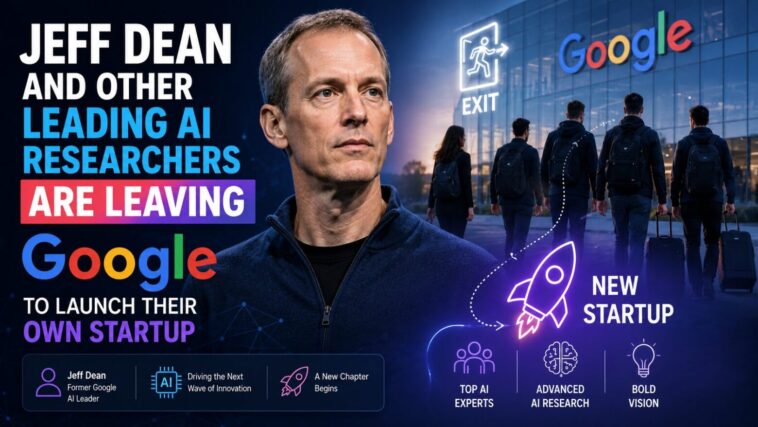
Jeff Dean is leaving Google. He’s one of the company’s longest-serving and most influential executives. Now he’s stepping away to launch his own AI startup.
He’s not going alone. Several other top Google researchers are joining him as co-founders. That includes Sanjay Ghemawat, a senior fellow and top engineer at Google. It also includes Quoc Le, a key AI researcher and founding member of Google Brain. Oriol Vinyals, a senior research scientist at Google DeepMind, is joining too. According to reports, Dean will serve as CEO of the new company.

Together, the group is launching Discovery Loop. It’s structured as a public benefit corporation. The mission is ambitious: use AI to dramatically speed up scientific research.
Read More: Google Rolls Out Age-Assurance Tools for Android Developers Globally
Discovery Loop plans to run thousands of experiments at once. The idea is to use powerful algorithms to launch and refine experiments simultaneously. That would partially automate the research process itself. It would also expand how much experimentation can happen at any given time.
The startup has another major goal too. It wants to use AI to help build even more powerful AI. This concept is known as recursive self-improvement. In theory, it could remove human iteration from the process almost entirely.
The company explained its thinking in a press release. It said science and engineering have driven massive progress for centuries. But that progress has always depended on slow, step-by-step human effort. That reliance, the company argues, has created a real bottleneck. Discovery Loop says it’s building advanced AI systems to change that. The goal is to use massive computing power to automate entire experimental cycles, from start to finish.
Using AI to speed up scientific discovery isn’t a new idea. It’s been a major interest across the science and tech worlds for years. Until recently, though, it stayed mostly experimental. Real commercial applications were limited.
Discovery Loop already has financial backing. Investors include Alphabet, Google’s parent company. The startup’s initial funding round is being co-led by Radical Ventures and Khosla Ventures. Other investors joined in as well, including Kleiner Perkins, Lightspeed, and Doerr Capital.
The founding team shared a joint statement about their vision. They said AI’s next major frontier isn’t just answering questions. It’s making actual discoveries. By speeding up how scientific and engineering work gets done, they believe the benefits of major new technologies can reach the world much faster.
Read More: SpaceX Doubles Revenue Through Anthropic, Google AI Compute Deals
Dean’s history with Google runs deep. He joined the company back in 1999. He was Google’s 30th employee. Over the years, he helped shape core parts of Google’s infrastructure. That includes the systems behind web crawling, indexing, and search queries. He also played a major role in developing Google Gemini’s multimodal models. Beyond that, he was a key figure in the company’s early AI research efforts.
Dean spoke about his vision in an interview with The New York Times. He said there’s a real opportunity to automate parts of the experimental process that have always relied heavily on human effort. According to Dean, that shift could lead to both more experiments and better ones. Over time, he believes that combination will drive real scientific breakthroughs.