

 Hajra Naz
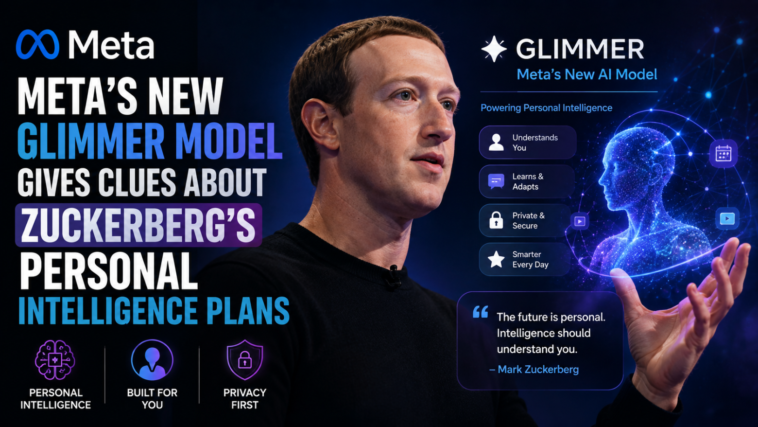
Meta released a major new model on Monday. It’s called Muse Glimmer. This is an open-weight model. It’s designed to power AI agents locally, right on consumer hardware. The release offers the clearest look yet at CEO Mark Zuckerberg’s vision. He’s often described that vision as “personal superintelligence.” Now, there’s a real product showing what that could actually look like in practice.
Glimmer is a 30-billion parameter model. It’s essentially an open version of Meta’s most powerful closed model. That model is called Muse Spark. Meta first debuted Muse Spark back in April. Glimmer’s weights are released under the Apache 2.0 license. That’s a highly permissive license. It means developers can freely download the model. They can also modify it however they need.

Glimmer is built for a specific purpose. It’s designed to run AI agents capable of handling multi-step tasks. That includes calling external tools. It includes writing and debugging code. It also includes working with files and screenshots.
These agents can execute tasks across extended workflows. Importantly, all of this can run locally. Users only need a Mac or PC equipped with a single consumer GPU. The model supports both text and images. According to Meta, it was trained across more than 100 languages.
Read More: Meta launches Muse Code AI agent for large codebases
Meta has specific use cases in mind for Glimmer. That includes managing schedules. It includes drafting messages. It also includes organizing files. These tasks typically require significant access to personal data. Meta’s approach handles that data differently, though. Instead of sending information to the cloud, Glimmer processes it directly on the user’s device.
This local-first approach lays the groundwork for a more privacy-conscious personal agent. Glimmer is also designed to stay “always-on.” According to Meta, it can operate anywhere, anytime, with or without an internet connection.
This vision connects directly to comments Zuckerberg has made before. Last year, he argued that advanced AI should empower individuals. He said it shouldn’t stay concentrated in the hands of just a few companies. At the same time, he warned about safety concerns. He said Meta would need to be careful about which powerful models it chooses to release openly.
Zuckerberg reinforced that same vision in a new letter published Monday. In it, he argued that distributing superintelligence widely carries real potential. He said it could begin a new era of personal empowerment. According to Zuckerberg, individuals could use this capability to reach their full potential. They could pursue their own interests. They could improve their lives and the world more than ever before.
Zuckerberg went further, outlining specific benefits. He described a capable personal agent working around the clock. That agent, he said, would work 24/7 on a person’s behalf. Its goal would be improving relationships, health, career, finances, home management, hobbies, and more. He also pointed to bigger opportunities.
Read More: OpenAI reportedly completes major $7 billion employee share sale
People could gain access to tools needed to start a new business. They could use those same tools to advance scientific progress. Perhaps the biggest promise, according to Zuckerberg, involves accessibility. He said everyone will have free or affordable access to these tools.
Still, access isn’t the same thing as ownership. That distinction matters here. Zuckerberg’s promise to distribute superintelligence widely comes with a catch. Meta is increasingly drawing a clear line. Some models will be released openly.
Others will remain firmly under the company’s control. Muse Spark, the more powerful model, stays closed. Its weights aren’t available to the public. Glimmer, the smaller model, works differently. It can be downloaded. It can be fine-tuned. It can run directly on a user’s own hardware.
Because of that distinction, Glimmer offers an early signal. It hints at where Meta may ultimately draw the line. On one side sits the AI Meta wants people to own and control themselves. On the other side sits more powerful intelligence, the kind that stays under the company’s own control going forward.