Hajra Naz
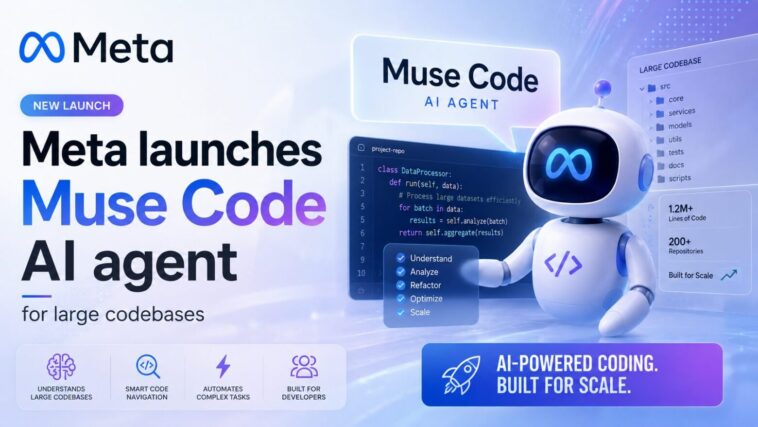
Meta has often been seen as a bit behind in the AI coding tools space. This week, the company made a move to close that gap. It released a new terminal coding agent. The tool is designed for programmers working on complex tasks across large codebases.
The new tool is called Muse Code. It’s currently available in beta. According to Mark Zuckerberg, Meta’s CEO, the tool can handle complete software engineering tasks across large repositories. He shared the news in a social media post on Wednesday. He said those tasks include planning changes, writing code, and validating the results.

Muse Code is easy to set up. It can be installed with a single command. Under the hood, it runs on Muse Spark, Meta’s previously released coding model. The tool is built to handle large projects efficiently. It does this by launching multiple agents that work at the same time.
Zuckerberg explained how this works. He said that when a task is large enough, the system splits it into separate sub-agents. Those sub-agents work in parallel, each operating in its own isolated workspace. Importantly, the user’s original working copy is never touched. Zuckerberg shared a specific example from testing. The tool reportedly built six different features for a game at the same time, with no conflicts between them.
This launch is a clear competitive move. Meta is trying to position itself against other major AI labs. That includes OpenAI, with its coding agent Codex. It also includes Anthropic, with its tool Claude Code.
Alexandr Wang spoke about the strategy behind this release. He leads Meta Superintelligence Labs and serves as the company’s AI chief. He told The Wall Street Journal that Muse Code could be a strong option for many workflows and use cases. He specifically highlighted cost as a major advantage.
Read More: Study Reveals AI Coding Tools Continue to Make Costly Mistakes
This release fits into a much larger pattern for Meta. The company has been investing heavily in AI development. In June, Meta expanded beyond its usual focus. Historically, the company mostly used AI to support its advertising business. That month, though, it entered the enterprise AI market for the first time. It launched a new agent built for customer service and support tasks.
Together, these moves suggest a broader shift in Meta’s AI strategy. The company isn’t just refining internal tools anymore. It’s actively building products aimed at outside developers and businesses. With Muse Code, Meta is signaling that it wants a real seat at the table in the coding-agent space, not just as a fast follower, but as a genuine competitor on cost, performance, and scale.