Hajra Naz
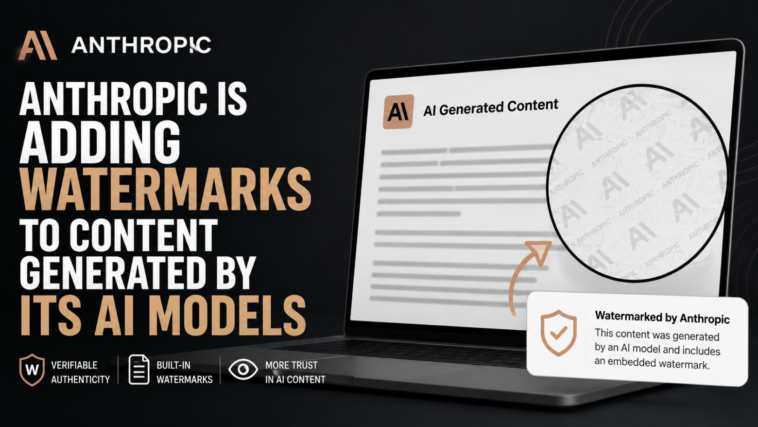
Anthropic made a significant announcement recently. The company will start watermarking text generated by its AI models. This includes Claude, its flagship product. The move is aimed at compliance with European regulations. Anthropic confirmed the change on an updated support page.
This update ties directly to a new legal requirement. The EU AI Act’s Transparency Code took effect on August 2. Under this code, AI companies must mark content that’s AI-generated or AI-edited. That marking needs to be identifiable by other systems, not just visible to humans.

Anthropic outlined exactly how this will work. All models released after August 2 will include watermarking technology automatically. This applies to both computer-generated text and files. For files specifically, Anthropic is using an established method. The company relies on the C2PA open standard for that purpose.
The rollout won’t stop at new models, either. Anthropic said it plans to extend watermarking support to older models over time. The company also addressed a key detail about how the watermark behaves. According to Anthropic, the watermark will travel with the text. That means it stays intact even after users copy and paste that text elsewhere.
You may also like to read: Does AI-Generated Content Rank on Google?
Anthropic explained this mechanism directly on its support page. The company said the watermark is embedded as part of the text itself. Because of that, it travels along with the text whenever it’s copied and pasted. It may even persist through certain types of editing. Anthropic also clarified where this watermarking applies. It said watermarking happens at the model level. That means the watermark will be present regardless of which Claude product or platform generated the text.
One detail remains unclear, though. It’s not obvious exactly how much editing would be required to remove the watermark entirely.
Anthropic also listed which products this watermarking will apply to. That includes the Claude platform API. It includes the standard Claude app. It also includes Claude Code, Claude Cowork, and Claude Tag.
This move fits into a much larger industry trend. Many platforms are now rushing to add watermarks to AI-generated content. Part of this push comes from user backlash. Another major driver is a desire to avoid regulatory scrutiny. Just last week, AI music platform Suno made a similar announcement. The company said it will begin marking tracks created on its platform. That decision followed a series of legal challenges against the company.
You may also like to read: Anthropic Unveils Claude Sonnet 5, a Lower-Cost AI Model for Agentic Tasks
Last month, newsletter platform Substack made its own move in this direction. The company partnered with Pangram to help flag AI-generated content. Substack’s CEO, Chris Best, addressed this trend directly. He specifically called out a practice he termed “Claudefishing.” That term refers to people using AI tools to generate content while passing it off as their own original writing.
Anthropic isn’t acting alone in this space, either. Several other major companies have made similar commitments. That includes Black Forest Labs, Google, Meta, Microsoft, OpenAI, and Synthesia. Each of these companies has agreed to adhere to the EU’s transparency code moving forward.