

 Hajra Naz
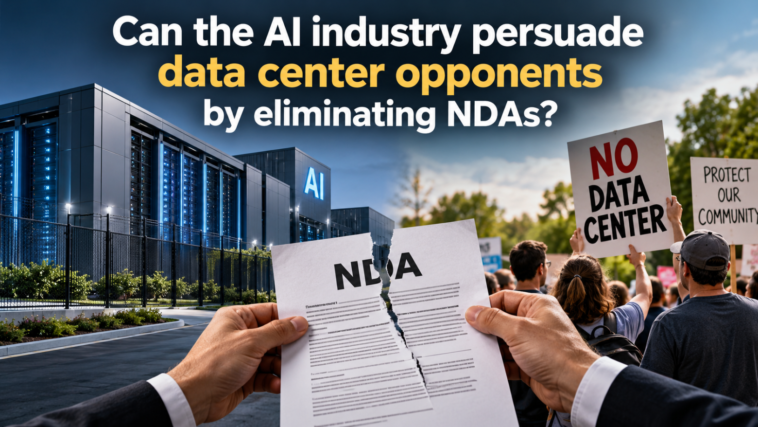
Amazon recently followed Microsoft’s lead on a key issue. The company said it will no longer use nondisclosure agreements (NDAs) while negotiating with local governments over data centers.
The Equity podcast hosts Sean O’Kane, Rebecca Bellan, and Anthony Ha discussed the news. The announcement came in the middle of a longer Amazon blog post. That post argues that data centers are actually good for communities.

The hosts agreed on some points and split on others. Rebecca was skeptical that the recent wave of data center moratoriums will have a lasting effect. Most of these pauses last only a year or two. The data centers in question won’t come online for years anyway. Anthony countered that data center backers clearly seem worried. Sean pointed to a different cause for the backlash. In his view, the industry communicates poorly.
Below is a preview of the conversation, edited for length and clarity.
Why NDAs Matter in Data Center Deals
Companies often use NDAs to keep a project’s details private during negotiations. That can include the company’s name, the site, and the incentives on the table. Local officials sign these agreements. Residents are left out of the loop. That’s why the practice draws so much criticism.
Sean O’Kane found it interesting that Amazon buried this news inside a larger blog post. He understood why the company didn’t lead with it. Still, he sees secrecy as the root of many problems the tech industry now faces. That’s true for AI broadly. It’s especially true for data centers.
There are many open questions about data centers. People worry about property values. They worry about electricity bills. They worry about water use in their area. Some of these worries may be real. Others may be inflated. Sean argued that much of the anger traces back to one fact. Many projects get negotiated in secret. Sometimes the public knows a data center is coming. It just doesn’t know who will use it.
Read More: Google Says SpaceX’s Starship Needs 1,800 Launches for Space Data Centers
The Uber Example
Sean said this is a long-standing tech industry habit. He pointed back to the mid-2010s, when Uber was expanding fast. Uber leaned heavily on this tactic with local governments.
He recalled one case from his time at The Verge. A freelancer wrote about a city outside Orlando. Uber was negotiating tax subsidies there. The subsidies would pay for rides to public transit after an Uber trip. The whole deal was negotiated in secret. That was frustrating on its own. The secrecy also made Uber more comfortable asking for other things.
For Sean, the lesson is clear. The industry needs more openness. He’s glad Amazon is moving that way. He’s not sure it will change much, though. People are deeply entrenched right now.
Do Moratoriums Actually Work?
Rebecca Bellan wondered what effect the change will have. Will it help communities delay or kill infrastructure that companies need? She noted that a significant number of moratoriums have passed. One was recently approved in San Francisco, which she called ironic.
Still, she spoke with people who deal with data centers every day. They told her something important. Most of these moratoriums last only a year or two. The buildouts won’t come online for two to five years anyway. Zoning and funding will delay them regardless. If pushback continues, it could have an effect. She’s just not sure how much.
Anthony Ha on the New York Moratorium
Anthony Ha said the moratorium he knows best is the one in New York. It’s a roughly one-year pause on permits for large projects. Technically, it lasts until the state finishes an environmental review. That review is expected to take about a year.
That leaves some wiggle room. Officials often frame these pauses as a chance to study the issue. They don’t say data centers are bad. That framing lets them reverse course later. They can say they studied it and decided it’s great.
Still, he thinks the builders are worried. He pointed to the “unhinged tweets” from figures like Trump and David Sacks. Only time will show how long and how deep the community resistance runs.
Read More: Nvidia plans $1.5B investment in SoftBank data center developer behind OpenAI
What Microsoft Did First
Anthony also noted that Microsoft made a similar announcement earlier this year. It said it would stop using NDAs with local governments.
He doesn’t expect this to turn opponents into supporters overnight. Ending NDAs won’t make everyone say, “Great, I’m in.” Still, it starts a better conversation. Opponents have long said they don’t know what the companies are doing. That’s because everything was negotiated in secret. Removing that barrier is a good first step.
A Communication Problem Across Tech
Sean returned to his main point. He sees a communication problem across the entire tech industry. It’s especially sharp now. We’re living in the era of “going direct.” Many people say you no longer need to talk to the media. Sean said he isn’t trying to defend his own industry. He just thinks the results speak for themselves.
The backlash over AI and data centers shows a pattern. The industry does a poor job explaining itself. Its leaders are often frustrated that people can’t picture how this technology helps them. Part of the reason is that the technology isn’t there yet. Part of it is that nobody explains it well.
The Tesla Abundance Example
Sean offered a second example. He wrote a story about Tesla and its mission statement. Tesla once called its goal “sustainable abundance.” It now calls it “amazing abundance.” A year later, the company still has no clear definition.
That surprised him for several reasons. Tesla released a multi-page PDF laying out the plan. Even Tesla’s biggest fans criticized Elon Musk for how vague it was. To Sean, it read like nonsense from a language model.
The Narrative Shift
Anthony said these stories made him think about narrative. For a while, the AI-driven future felt like it was being forced on people. The message was that it’s inevitable. Get on board or get left behind.
That future is still moving ahead in many ways. In a few key areas, though, obstacles have appeared. Anthony likes that. It means companies have to make their case. They can’t just say, “This is the future, shut up.”
On Tesla, he found something else striking. The surprise wasn’t that Tesla lacks a definition of abundance. It was that Tesla made that promise at all. It shows how strange the relationship has become between Tesla and its most devoted supporters. For them, it isn’t just about selling cars. It’s about a vision for remaking society. Or at least that’s what they’re being sold.
Read More: NVIDIA May Back OpenAI With $250 Billion for a Huge Data Center Project
Why This Matters
The NDA decisions by Amazon and Microsoft show something about public trust. Data centers need land, power, water, and local approval. Communities have a say in all four. Secrecy makes people assume the worst.
Openness doesn’t guarantee support. It does give residents facts to work with. That can lead to better deals. It can also lead to firmer limits. Either result is healthier than distrust.
Companies that explain their projects early may face less resistance later. Companies that stay silent may keep facing it.