

 Hajra Naz
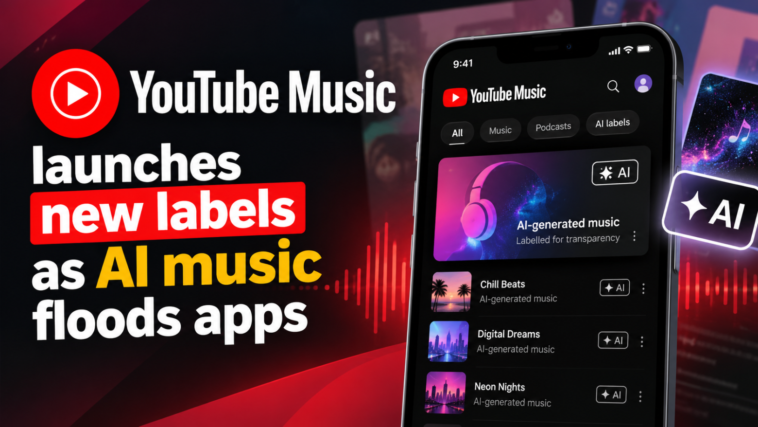
YouTube Music announced a new labeling system on Wednesday. It aims to make songs created with generative AI more transparent. Listeners can now easily spot tracks made with AI. That includes AI used in composition and vocals.
Where the Labels Appear
The label shows up on the player page. Clicking it gives more detail. It explains the specific role AI played in the track’s creation.

The labels will also extend to the main YouTube app.
How YouTube Identifies AI Music
YouTube says it worked with various music partners. It also used its own detection tools to find AI-generated music. According to its help page, partners can declare their use of generative AI. They choose one of three designations: Fully Gen AI, Partly Gen AI, or No Gen AI.
“Fully Gen AI” covers tracks made entirely by AI. “Partly Gen AI” covers works with AI-generated parts. In those cases, artists may have added their own live elements. Tracks edited with pitch-correction tools like Auto-Tune fall under “No Gen AI.”
Read More: YouTube Launches New AI Tools for Creators within its Studio app
How Other Platforms Compare
AI-generated music is spreading fast across streaming services. Each platform has taken its own approach.
- Apple Music plans to add “Made With AI” labels later this year. They’re part of its AI Transparency Tags.
- Spotify also has AI labels. It runs a music spam filter too.
- Deezer has taken one of the stricter stances. It reported in July that it receives nearly 90,000 fully AI-generated tracks every day. The platform labels detected AI music. It leaves that music out of algorithmic recommendations and editorial playlists. It also withholds royalties from fraudulent streams. Deezer is working on an option that lets users filter out AI-generated music.
- TIDAL labels recordings it identifies as fully AI-generated. Listeners can turn them off. TIDAL also excludes these recordings from royalty attribution.
YouTube’s Different Approach
YouTube is choosing disclosure over blanket restrictions. Its labels aim to tell listeners how AI shaped a song. AI involvement alone doesn’t make a track ineligible for monetization.
YouTube also experiments with AI music creation itself. One example is Dream Track. It lets select creators generate soundtracks. Those soundtracks use AI-generated versions of participating artists’ voices.