

 Hajra Naz
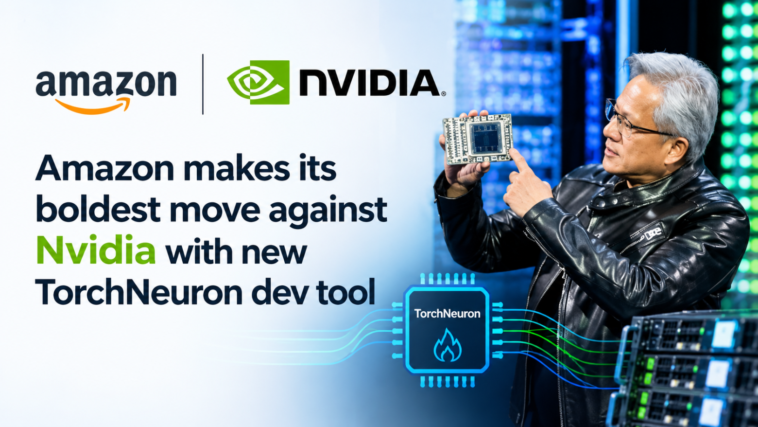
Amazon Web Services launched a new software tool called TorchNeuron on Monday. The tool enables artificial intelligence startups to easily transition their applications onto Amazon’s proprietary Trainium chips. Through this release, Amazon directly targets the software advantages that established Nvidia as the default hardware vendor across the AI sector.
TorchNeuron integrates directly with PyTorch, an open-source framework widely used by engineers to build, train, and execute AI models. Amazon claims that developers can migrate PyTorch applications to Trainium hardware by modifying a single line of configuration. This streamlined process eliminates the need for extensive code rewrites.

Breaking Nvidia’s Deep Integration with PyTorch
Amazon estimates that approximately 85% of modern AI applications rely on PyTorch. Meta originally created the framework, but the project has operated under the Linux Foundation since 2022.
For years, Nvidia invested heavily in optimizing its proprietary CUDA software architecture to support PyTorch seamlessly. CUDA allows applications to run efficiently across Nvidia GPUs and enterprise hardware. Consequently, Nvidia’s hardware architecture became deeply embedded within the PyTorch ecosystem by default.
Because TorchNeuron builds upon standard PyTorch conventions, developers already familiar with the framework can adopt it immediately.
Amazon is not the first cloud provider attempting to simplify chip integration on the platform. Developers using PyTorch can already port workloads to AMD GPUs or Apple silicon using minor configuration updates.
Read More: Amazon just tripled its Nvidia chip orders over rising AI demand
Enterprise Cloud Capabilities Versus Specialist Providers
Amazon contends that switching to Trainium offers unique advantages beyond ease of migration. The company emphasizes that adoption grants startups direct access to the broader AWS ecosystem.
AWS executives argue that this approach provides a stronger foundation than specialized cloud vendors tied heavily to Nvidia hardware, such as CoreWeave, Nebius, and Firmus.
AWS Annapurna Labs Vice President of Technology Software Colin Brace highlighted these infrastructure benefits. He noted that building on AWS prevents founders from relying on single-purpose compute vendors. He emphasized that AWS provides the necessary infrastructure to scale applications rapidly from initial prototypes to full production environments.
Optimizing Infrastructure Costs for AI Startups
AWS claims that Trainium chips deliver significant cost savings across entire development lifecycles. The underlying hardware handles both initial model training and ongoing operational inference. This dual functionality integrates directly with core cloud services, improving overall workload economics.
Brace explained that Trainium delivers superior price-performance ratios by unifying training and inference onto a single platform. He cited speech recognition provider Deepgram as a key example. After migrating workloads to Trainium through native PyTorch integration, Deepgram processed 70% more audio per dollar while maintaining production-grade accuracy.
Read More: Amazon’s Panos Panay sees AI hardware replacing mobile apps
Pushing for Hardware-Agnostic AI Development
Amazon’s strategy extends beyond attracting developers to its own cloud platform. The company aims to make the core PyTorch framework less dependent on Nvidia architecture.
To achieve this, Amazon plans to contribute software modifications directly back to the main open-source PyTorch repository.
In its official product announcement, Amazon confirmed plans to collaborate with the broader PyTorch community. The initiative focuses on removing legacy code that binds the framework to specific chip architectures. The goal is to establish a truly hardware-agnostic platform for all AI developers.
This open-source push benefits competing hardware vendors and cloud platforms attempting to challenge Nvidia’s market share. Historically, PyTorch aimed to abstract away complex hardware management details for software engineers.
It remains to be seen whether reducing Nvidia’s direct integration will grant developers greater choice and lower costs or simply introduce new configuration challenges.
Ultimately, uncoupling PyTorch from Nvidia hardware could carry major long-term implications for the GPU manufacturer. As Brace noted, the broader objective involves removing vendor lock-in and offering developers genuine operational choices.