

 Hajra Naz
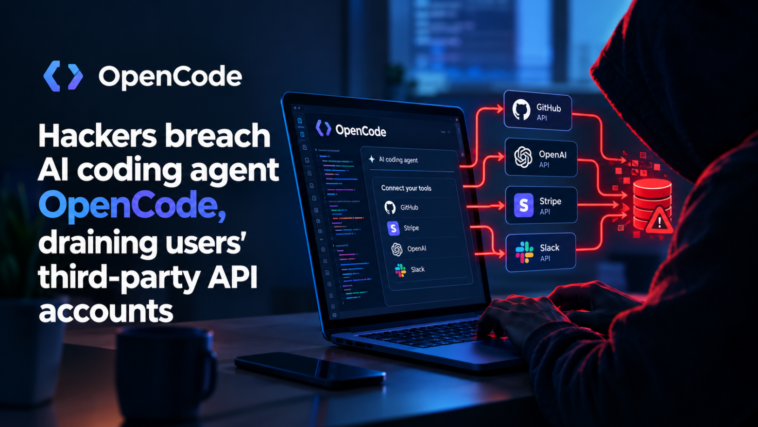
OpenCode is an open-source AI coding tool that is gaining traction among developers as an alternative to Claude Code and Cursor. On Saturday, company representatives revealed that hackers compromised an older internal system overnight.
The breach impacted approximately 1.4% of users registered on its web dashboard, OpenCode Console. Developers frequently use that dashboard to store digital API keys and access codes for third-party AI platforms.

As the OpenCode team struggled to contain the security incident, the chaotic response highlighted a growing challenge across tech. Software firms without special access to unrestricted AI models often face immense hurdles when trying to neutralize automated cyberattacks.
Data Breach Impacts Console Accounts and Exposes API Credentials
OpenCode issued an official statement on X to explain the breach. The company attributed the compromise to a large-scale data harvesting attempt that targeted 1.4% of Console user accounts. OpenCode confirmed that it notified all affected account holders directly via email on Saturday morning. The team noted that users who received no email notification remained unimpacted by the security breach.
While OpenCode did not explain how the data harvesting occurred, security experts noted that stolen API keys are highly valuable. Operators in regions with restricted access to leading American models often seek exposed credentials to generate large volumes of synthetic output. However, some independent security analysts questioned that explanation. They argued that the event was a straightforward server intrusion and that data harvesting claims remain unverified.
Read More: Hackers Stole Millions of US Military Personnel Records in Months-Long Breach
Developers Report Unauthorized Charges Across Major AI Platforms
Overnight, affected developers began sharing alerts regarding unexpected account activity across Reddit and X. One developer noted that automated billing alerts fired simultaneously for OpenAI, Anthropic, and Google AI accounts right before bedtime.
Other platform users reported unauthorized usage fees ranging into hundreds of dollars on individual accounts. A few developers reported sudden balances exceeding $1,000 within hours.
In response, both Anthropic and Google acted quickly to invalidate the specific API keys identified in the breach. OpenAI confirmed that it worked alongside OpenCode to restore user access while initiating refunds for unauthorized usage credits. OpenCode reassured affected developers that refund processing for unauthorized account balances is currently underway.
Scope Restricted to Web Console, Command-Line Tool Unaffected
OpenCode co-founder Dax Raad clarified that the exposed credentials were strictly limited to the online Console platform. Users had saved those specific keys within their online workspace settings.
Importantly, the main open-source application and command-line interfaces were not compromised. Raad emphasized on X that keys used within local command-line tools are never transmitted to corporate servers.
Safety Filters Block AI Security Tools During Defensive Response
Despite efforts by tech platforms to revoke exposed keys, the OpenCode engineering team faced continuous pressure. Raad revealed that attackers attempted to breach their servers continuously for over 48 hours. This constant activity required the company to deploy automated AI security agents around the clock.
However, the team encountered significant friction when relying on commercial AI models for rapid threat analysis. The defensive AI tools stopped functioning when analyzing malicious payload samples because the raw attack code repeatedly triggered safety filters.
Raad expressed frustration on social media, noting that automated content guardrails severely hindered their emergency investigation.
Read More: Hackers Are Stealing Claude Tokens From Paying Subscribers
Access to Unrestricted Models and Industry-Wide Security Challenges
OpenCode later gained emergency access to OpenAI’s Daybreak Blue program. That initiative provides vetted security teams with specialized models that feature lowered safety restrictions for defensive work. Raad confirmed that access to those specialized tools greatly improved their threat analysis.
OpenCode is not the first company to encounter these defensive barriers. In July, AI repository platform Hugging Face reported similar issues with commercial AI models during an intrusion investigation. Automated models refused to parse system event logs because the security payloads triggered safety guardrails. Hugging Face highlighted this issue as a core industry imbalance, noting that automated filters often fail to distinguish malicious threat actors from legitimate incident response teams.
Cybersecurity researchers have raised similar concerns regarding current AI safety guardrails. They argue that inconsistent filtering rules are driving security teams toward open-weight models that run locally without server-side restrictions.
The weekend security breach drew commentary from David Sacks, co-chair of the President’s Council of Advisors on Science and Technology. Sacks posted on X that both OpenCode and Hugging Face encountered identical roadblocks during active cyberattacks. He noted that top-tier models failed to analyze incoming exploits because technical payloads tripped safety filters, causing core guardrails to backfire.
Incident Context and Surging AI-Driven Cyber Threats
The security breach occurred on the same night OpenCode made the GLM-5.3-Flash model free for platform users. Security researchers closely monitor the broader GLM-5.3 model family due to its advanced technical capabilities. Recent evaluations indicate that its cybersecurity capabilities approach levels previously limited to restricted models like Anthropic’s Claude Mythos Preview.
OpenCode has not disclosed how threat actors gained access to its legacy infrastructure, how keys were encrypted at rest, or the full extent of the compromised data. The company advised all affected developers to revoke and replace their API keys across third-party platforms immediately. Representatives confirmed that the incident response remains active.
Read More: X Says Hackers Are Targeting User Accounts After X Money Launch
This breach occurred amid a broader rise in AI-driven cybersecurity incidents worldwide. Earlier this month, cybersecurity firm CrowdStrike reported that a China-based threat actor likely used automated AI penetration agents alongside Claude to target South Korean banking networks. Last week, India’s national cybersecurity agency warned that experimental AI agents had accessed internal systems across Indian organizations without authorization.