

 Hajra Naz
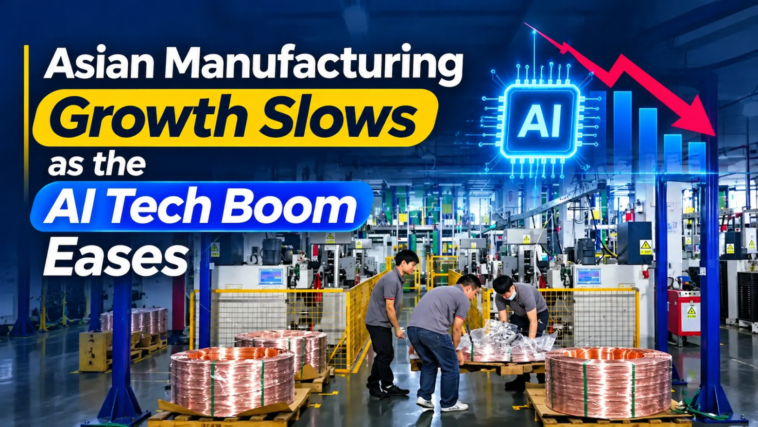
TOKYO: Asian factory output continued to expand throughout October. However, growth lost speed across major chip-exporting nations, according to private surveys published on Monday. The figures suggest that the rapid AI boom may be losing steam as financial markets begin questioning the sector’s ultimate profitability.
The underlying data highlights increasing pressure on export-driven economies. Prolonged military conflict across the Middle East continues to keep global fuel and food costs high. These elevated expenses are directly hitting consumer spending and corporate confidence, even as baseline demand for microchips and artificial intelligence hardware stays resilient.

Manufacturing growth decelerated in China, Japan, South Korea, and Taiwan during October. The survey results indicate that economic fallout from the US-Israeli conflict with Iran is starting to cancel out benefits gained from strong global tech orders.
“Strong chip and AI demand had masked soft spots in Asian and global economies. But that’s becoming hard to sustain with the Middle East war dragging on for so long, pushing up fuel and food prices,” said Toru Nishihama. He serves as the chief emerging market economist at the Dai-ichi Life Research Institute located in Tokyo. Nishihama added.
“High inflation is hurting Asian consumption. Intensifying price competition from China is also weighing on rival exporters like Japan and South Korea”
Read More: Is the AI Boom Losing Momentum? Experts Reveal the Risks
The RatingDog China General Manufacturing Purchasing Managers’ Index (PMI), compiled by S&P Global, registered at 52.0 for October. Any reading above the 50-point line marks economic expansion rather than contraction. However, October’s number fell slightly from September’s mark of 52.1.
This private reading followed official government data released on Saturday. Those state reports revealed that China’s broader factory activity contracted during October, marking the third monthly drop in four months.
“The PMIs suggest that China’s economic activity lost momentum in October following September’s pick-up. Manufacturing softened a touch, but foreign demand still looks resilient,” stated Nguyen Hoang Nam, a China economist working at Capital Economics.
“More worrying was the sharp reversal in construction activity and expectations, suggesting that firms have become less confident that fiscal support will provide a substantial boost over the rest of the year,” Nam observed.
Japan’s PMI slipped to 53.3 in October, down from 54.1 in September, according to S&P Global’s research. This shift represents the country’s slowest growth rate in seven months as factory output and new commercial orders cooled down.
South Korea’s industrial sector grew at its slowest eight-month pace due to weaker production numbers and softer overall market demand. South Korea’s PMI index dropped from 53.9 in September to 51.3 in October.
Taiwan’s manufacturing PMI fell to 54.9 in October compared to 56.7 recorded in September.
Read More: Then And Now: How AI Mirrors the Internet Boom
In contrast, several Southeast Asian nations saw factory production expand at a faster pace than the month before. Vietnam, Indonesia, and Malaysia all reported accelerated manufacturing growth rates.
Overall, Asia has outpaced many rival economic regions because local manufacturers capitalized on massive global demand for AI-related technology and semiconductors.
However, the International Monetary Fund has warned that Asia’s total economic growth will likely moderate heading into next year. The IMF highlighted growing risks stemming from Iran-related energy shocks alongside potential market corrections within the artificial intelligence sector.
The IMF stated it currently expects Asian economic growth to reach 4.8% in 2026 before easing to 4.4% in 2027. While these revised figures mark an upgrade from April forecasts, they still reflect a gradual deceleration from the 5.0% growth rate achieved in 2025.