Ahmed Shaami
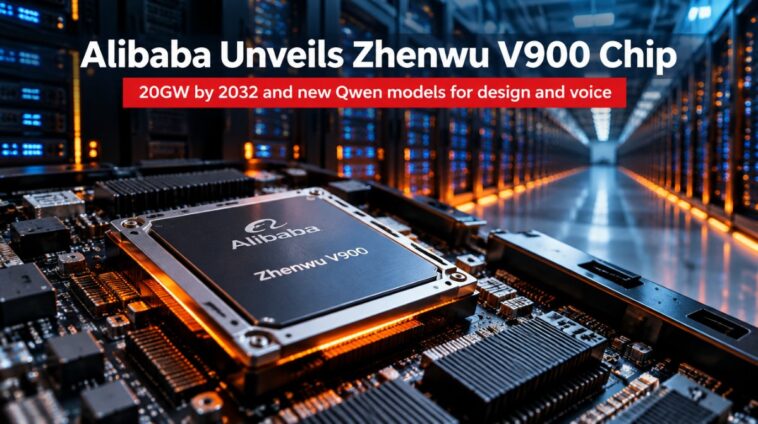
Alibaba used its Apsara Conference in Hangzhou on 22 September 2026 to unveil the Zhenwu V900, an in-house AI chip it says delivers three times the performance of its predecessor, and to set a target for Alibaba Cloud’s global data center capacity to pass 20 gigawatts by 2032. The company also confirmed that Qwen 4 is in training and that its Qwen 4.5 and Qwen 5 series are projected to scale to between 5 and 10 trillion parameters.
For freelancers, the chip is the headline but not the part that touches their income. Alongside it, Alibaba announced image, voice and translation models built for exactly the services many Pakistani sellers list on Fiverr and Upwork.

A chip built for very large clusters
Per Alibaba Cloud’s announcement, the V900 comes from T-Head, Alibaba’s chip design unit. It carries 216 GB of memory and 1,200 GB/s of inter-chip bandwidth, supports the low-precision FP8 and FP4 formats used to cut inference costs, and is scheduled for mass production and commercial release in the first quarter of 2027. T-Head says its Zhenwu chips already serve more than 650 customers in sectors including automotive, finance and manufacturing.
The chip is designed to work in bulk. TechNode reports that more than 1,000 V900 chips can operate as a single system, and Alibaba says its new supernode server can support a cluster of up to 500,000 cards. Supernodes built on the older Zhenwu M890 are already in commercial use running models with more than 2 trillion parameters, including Qwen3.8 and Moonshot’s Kimi K3. T-Head also set out a roadmap for its Yitian 720 and 730 server CPUs, due in 2027.
The strategic point is self-reliance. With US export rules restricting China’s access to Nvidia’s most advanced chips, Alibaba is building its own stack from processor to model, and the 20GW target signals how much computing it expects to sell on top of it.
Which freelance services are in Qwen’s sights?
Three of the model announcements map directly onto common gig categories:
- Qwen-Image 3.1, due later this year, is described as optimised for creative design and e-commerce marketing, with native transparent-background generation and image editing. Alibaba claims it cuts visual design turnaround “from hours to seconds”. Product photo cleanup and background removal are among the most crowded entry-level gigs on freelance marketplaces.
- Qwen-Audio-3.1-TTS-Next generates dialogue and ambient sound together from a text script, and Alibaba names audiobooks, film and television, podcasts and games as target uses. That is voiceover and audio production work.
- Qwen3.8-LiveTranslate, a simultaneous interpretation model, cuts latency from 2.8 to 2.3 seconds according to the company, close to a 20% reduction.
None of this removes demand for designers, voice artists or translators overnight, and Alibaba’s timing and quality claims are its own. But when a cloud giant names your service category in a launch announcement, the price of the basic version of that service tends to fall. The safer position is the layer above generation: art direction and brand consistency for e-commerce stores, script editing and quality control for audio, and review and localisation for machine translation, sold as part of a bigger package. Freelancers who already use Qwen models, which beingguru looked at in our Qwen3.8 analysis, are better placed to sell that layer.
Self-improvement, by Alibaba’s own numbers
Alibaba also reported progress on recursive self-improvement, where a model helps train and improve itself. Over a month of fully automated runs, it says Qwen3.8-Max completed 33 improvement cycles and raised its Artificial Analysis score from 40 to 45. In a chip design test, the model ran for more than 60 hours and made over 10,000 design tool calls to produce chip bus modules with 42% less area and no loss in performance. These are company-reported results and have not been independently verified.
What to watch before the V900 ships
The next milestones are concrete. Qwen-Image 3.1 is promised before the end of 2026, the V900 goes on sale in Q1 2027, and the Yitian CPUs follow later that year. Alibaba also launched AgentCore, a platform for building and running business AI agents, and Agent Context, a memory service it says cuts token usage by up to 67% in tasks such as customer service and coding. Pricing for these in Alibaba Cloud’s international regions will decide whether small agencies and freelancers outside China treat them as a real alternative to US providers.