Hajra Naz
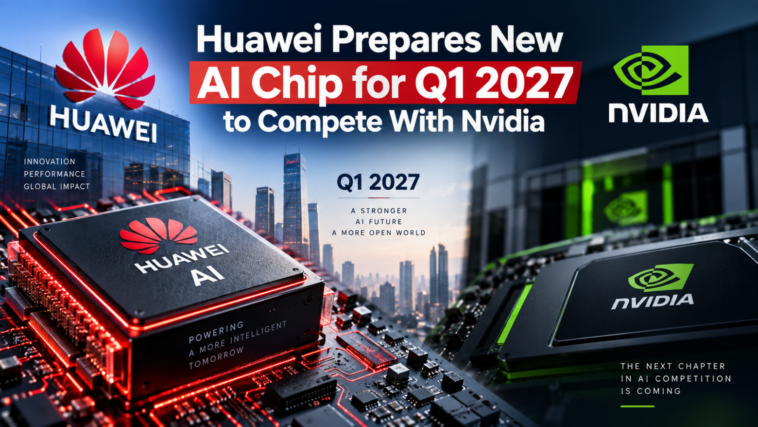
Huawei is moving up the launch date for its next-generation AI chip. That’s the Ascend 960DT. The company announced this shift to the first quarter of 2027. This move comes as Huawei races to challenge Nvidia directly. Huawei made this announcement Thursday at its Huawei Connect conference.
The Chinese tech giant had previously planned something different. It aimed to launch this chip in Q3 of 2027. A Huawei spokesperson confirmed this earlier timeline.

“The Ascend 960DT is expected to be ready in Q1 2027. Ascend 960 chips are launching ahead of schedule, doubling performance and advancing year by year,” the spokesperson said. They added that David Wang, Huawei’s rotating and acting chairman, announced this updated timeline at Huawei Connect on Thursday.
This announcement arrives just one week before a significant diplomatic meeting. U.S. President Trump and Chinese President Xi Jinping are set to meet on September 24 in Washington, DC.
Huawei is working toward an ambitious goal. The company wants to turn hundreds of thousands, and eventually millions, of AI chips into one giant computing system. Huawei calls this approach its “Peerium Computing Architecture.” This system relies on UnifiedBus.
That’s Huawei’s technology for linking processors with memory, storage, and networking hardware. Eric Xu, Huawei’s rotating chairman, addressed this approach directly. He said the company is using this new architecture to build larger AI computing systems. These systems are designed for both training and inference tasks.
Huawei’s Atlas 950 SuperPoD and SuperCluster represent the first systems built on this architecture. According to the company, an Atlas 950 SuperCluster can connect up to 256,000 accelerator cards.
Read More: We Can Handle AI Safety Ourselves and We Don’t Need AI Regulation, Says Nvidia’s Jensen Huang
Still, this accelerated chip timeline raises some questions about Huawei’s broader AI systems. China tech analyst Rui Ma addressed this discrepancy on X. She noted that Huawei had previously said its Atlas 960 SuperPoD would scale to 15,488 Ascend 960 chips.
However, this week’s announcement referenced a much smaller system. That system contains just 4,096 chips. “The chip itself is coming WAY earlier, but the SuperPoD they announced is much smaller than what they originally laid out,” Ma wrote.
Huawei has continued advancing its chip ambitions despite ongoing challenges. That includes U.S. restrictions on China’s access to advanced semiconductor technology. Ma argued these restrictions are unlikely to stop China’s broader semiconductor pursuit.
“I think it’s futile to stop China’s development in semiconductors because the stakes for self-sufficiency are just too high at this point,” she wrote.
Trump has pushed back against calls from AI industry leaders recently. Those leaders have urged slowing AI development due to safety concerns. Trump argues the U.S. needs to maintain its competitive lead over China instead.
Meanwhile, Xu offered a different perspective on this debate. He argued that China needs to accelerate AI development to catch up with the U.S. According to the Financial Times, Xu said Chinese companies need to advance further first. Only then can they fully understand and address risks posed by more powerful AI systems.