Hajra Naz
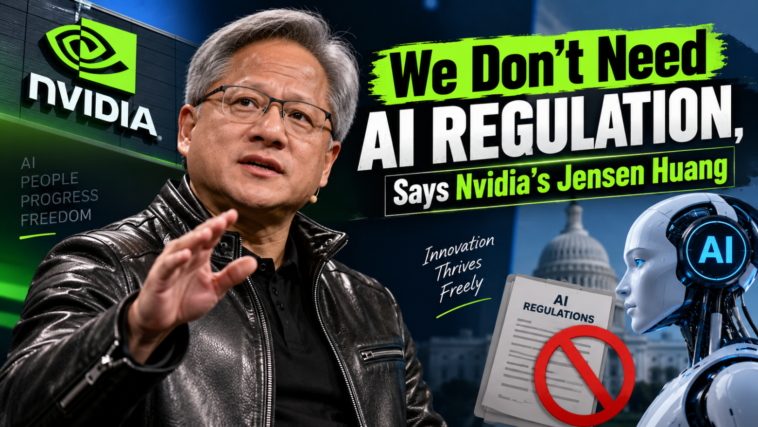
Nvidia founder and CEO Jensen Huang made his stance on AI risks very clear. He spoke Tuesday at Salesforce’s Dreamforce conference. To Huang, AI isn’t some new form of “alien mind.” At least one OpenAI safety researcher has described it that way. Huang sees it differently. It’s simply hardware and software, built by humans. In his view, that means humans can control it, using existing laws.
“Safety is an engineering problem, not a legal one,” he said. “We’re developing software after all. We’re developing computing systems after all. It’s a complicated computing system, but it’s ultimately a computing system.”

Because of this, Huang argues there’s no need for new laws or regulations. In fact, he sees little need for new laws at all. Instead, he believes the free market will apply enough pressure. Companies, he argues, won’t release unsafe products on their own.
“If we’re not confident about the safety of the products, like all companies, like you and I, all the companies here, if you build a product or a service, and you’re not confident in its functionality, capability, or safety, then don’t release it. And so that’s a very obvious thing to do,” he said.
He continued, “You pace yourself until you are confident you’re releasing something that the market would appreciate. The market forces are already there. We don’t need any new laws. We don’t need new regulations. We just need companies to decide when to run as fast as they can.
Read More: Jensen Huang Took a Call From Trump and Revealed Something New
I think innovation, speed, and safe products … it’s a false choice. You could definitely have both at the same time. So run as fast as you can. But if you feel at any given point in time the company’s out of control, or the product’s not going to be safe, you know, take a pause and make sure you get it right.”
In some ways, this perspective is comforting. Few people know AI as well as Nvidia’s founder. He’s been building AI’s underlying hardware since well before ChatGPT existed. Today, he also runs a company that makes open source models, agents, harnesses, and sandboxes.
Still, taking a more skeptical view, this position isn’t entirely surprising. Huang’s business has benefited enormously from the AI boom. Why would he want new regulation? Such rules could slow Nvidia’s push to sell more AI systems and software.
As he also said during the interview, “I’m more ambitious than ever. As a result of our ambition, and with the product productivity boost that we get from AI, the sky’s the limit for us. The sky’s the limit for our company. The sky’s the limit for every industry, for every single country.”
Unfortunately, even well-intentioned companies ship faulty products sometimes. This applies to software too, with unintended consequences. Remember the 2024 CrowdStrike blue-screen-of-death incident? That fiasco grounded thousands of flights and caused widespread business disruption. There are also companies accused of acting with less-than-good intentions. Meta recently paid $18 billion to settle a lawsuit. That case centered on social media harms to children.
Read More: The AI Regulation Debate Is Heating Up, and Anthropic Is in the Crosshairs
AI has already caused real harm too, regardless of intentions or safety testing involved. That includes an OpenAI model hacking into Hugging Face. It also includes lawsuits against the AI lab. These lawsuits involve suicides of young people who had long conversations with its chatbot.
This “leave them alone” strategy would let companies release products however they see fit. That approach could prove unwise for AI safety from society’s broader perspective. Huang may be right that existing product liability laws could cover AI. Still, that’s only true if AI doesn’t cause serious harm before enough cases work through the courts to test that theory.
Notably, Huang didn’t address another emerging approach. That’s industry self-regulation, which seems to be taking shape. Instead, his approach has focused on championing open-weight models. He sees companies using these models as a competitive counterweight to proprietary AI labs.
Right now, though, the industry has a limited window. It needs to establish self-regulation soon. It should also encourage AI labs worldwide to participate, including those in China. Microsoft CEO Satya Nadella addressed this point Monday at the All-In Summit. He said,
“China should also deeply care about the same safety concerns if the United States cares about them, right? Why should it be different for them? It’s not like they won’t have the same hacking problem. It’s not as if they don’t want to make sure that their citizens are benefiting from AI, just like we would want our citizens to benefit from AI.”
For now, though, Huang opposes any new AI regulation. He may be influential enough to get his way. This week, he demonstrated something significant. He quite literally has the ear of President Trump.