

 Hajra Naz
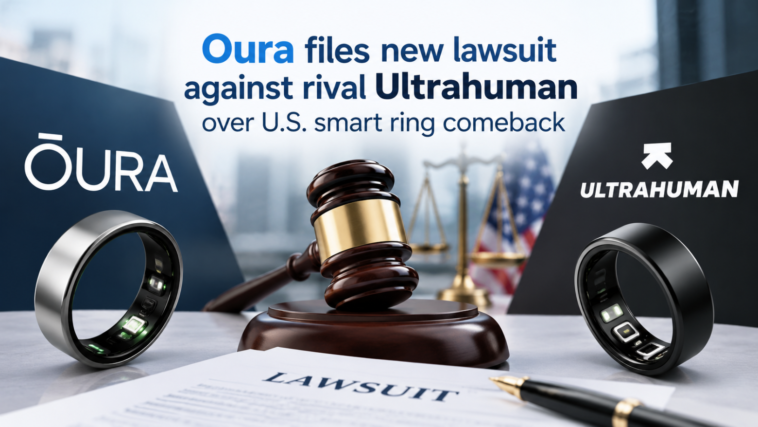
Smart ring manufacturer Oura has filed a new lawsuit against its Indian competitor Ultrahuman. The legal action seeks to block U.S. sales of the Ultrahuman Ring Pro. This move comes just months after a product redesign allowed the Bengaluru-based startup to return to the American market following an earlier import ban. The case marks the latest in a series of patent disputes. Oura has launched against rivals in the smart ring space, including Samsung and RingConn.
In a complaint filed Thursday in a Texas federal court, Oura alleged that Ultrahuman’s Ring Pro violates two of its patents. These patents cover the ring’s overall physical design and internal electronic components, including its battery and sensor hardware. Oura is asking the court for monetary damages and a permanent injunction that would stop Ultrahuman from selling the product in the United States.

Ultrahuman launched its redesigned Ring Pro in February. The company secured a favorable ruling from U.S. Customs and Border Protection in March, which paved the way for its return to the U.S. market. That customs decision followed an import ban on Ultrahuman’s previous device, the Ring Air. That ban took effect after Oura won a patent infringement ruling from the International Trade Commission in August of last year.
An Oura spokesperson stated that Ultrahuman has a clear history of copying Oura’s technological innovations. The spokesperson cited the 2025 ITC ruling as proof of past infringement. Oura claims that while Ultrahuman introduced a redesigned ring, the company failed to fix ongoing patent violations and continues to capitalize on Oura’s market leadership.
Oura argues that the earlier Customs ruling applied only to the single patent involved in that specific dispute. It does not cover the two patents cited in this latest lawsuit, which are patents D804,471 and 12,769,363. Oura stated in its court filing that it was forced to take legal action to protect its intellectual property rights.
One of the patents in the new lawsuit, patent 12,769,363, was issued very recently. The U.S. Patent and Trademark Office granted it to Oura on October 20, just two days before Oura filed the complaint. The patent details a smart ring construction containing internal parts like a curved battery, circuit board, magnets, and integrated sensors.
Oura also listed Texas electronics manufacturer SVTronics as a co-defendant in the legal action. The lawsuit claims that SVTronics produces the Ring Pro at a manufacturing facility in Plano, Texas, under Ultrahuman’s direct control. The complaint asserts that both companies infringe Oura’s patents through the local manufacture, importation, and distribution of the device inside the United States.
Read More: Smart Ring Maker Ultrahuman Launches AI Biological-Age Model in the UAE Market
Ultrahuman Responds to the Legal Challenge
Ultrahuman co-founder and CEO Mohit Kumar expressed confidence in the Ring Pro design and stated the startup will fight the allegations. Kumar noted that Oura chose to assert entirely new patents, including one issued just two days before the filing. He stated that Ultrahuman will defend its position through formal legal channels. He added that no current court order impacts the Ring Pro, and the device remains available for purchase across the United States.
The two wearable companies have been involved in legal battles since 2023. Oura originally sued Ultrahuman over its Ring Air model, which had helped the startup build a brand presence in the American market. Oura then filed a separate case before the U.S. International Trade Commission in 2024. That case led to last year’s ruling and the resulting import ban on the Ring Air.
Ultrahuman is not the only competitor facing legal pressure from Oura. The Finnish wearable maker has pursued similar patent infringement claims against rival manufacturers, including Samsung, RingConn, Circular, and Zepp Health. Several of those disputes resulted in licensing agreements, with companies like RingConn and Circular agreeing to pay ongoing royalties to Oura to keep selling their hardware.
Smart Ring Market Expansion and Financial Moves
This legal battle comes as the global smart ring category experiences rapid growth. Market research firm IDC projects global smart ring shipments to grow 12.8% this year to 4.9 million units, with total volume expected to reach 6.3 million units by 2030. While Oura holds a commanding share of the category, Ultrahuman has emerged as a key international competitor.
The lawsuit also follows Oura’s decision to pause its planned $2.2 billion initial public offering due to broader market uncertainty. Despite the delayed IPO, the company continues to update its software platform, recently rolling out new fitness metrics to help users track cardiovascular health during workouts.
Meanwhile, Ultrahuman raised $70 million from investors in September, including backing from Qualcomm Ventures and Labcorp. That funding round valued the startup at roughly $365 million. Ultrahuman is currently collaborating with Qualcomm on a next-generation smart ring capable of processing software directly on the device, as it aims to expand beyond health tracking into AI features and interactive gaming.