Hajra Naz
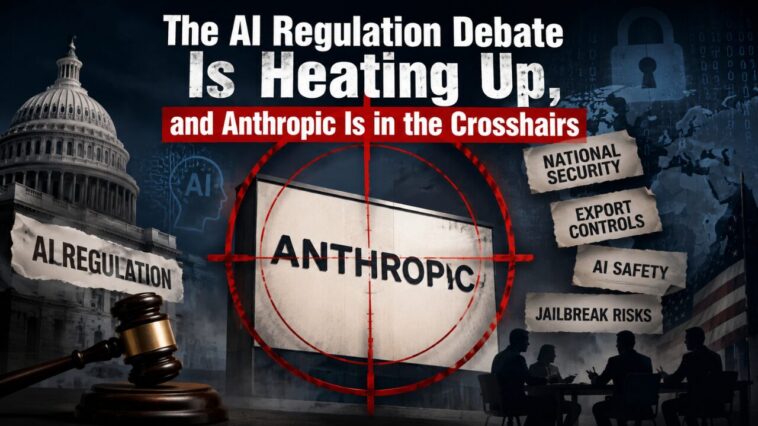
Just days after its launch, Anthropic’s most advanced public AI model was suddenly removed from customer access.
The Trump administration labeled the model a national security risk after learning about a jailbreak. A jailbreak is a technique that allows users to bypass an AI model’s built-in safety restrictions. Following the discovery, the government imposed export controls on the model. The restrictions were so broad that some Anthropic employees were also prevented from using it.

Anthropic disagrees with the government’s assessment. The company says the vulnerability does not justify such a severe response.
The dispute highlights the confusing state of AI regulation in the United States. Many experts agree that the government should play a role in AI safety discussions, especially when national security is involved.
However, the conflict between Anthropic and federal officials has exposed a larger issue. The United States still lacks a transparent and consistent system for regulating artificial intelligence. Critics warn that this uncertainty could slow innovation and weaken the country’s position in the global AI race.
Anthropic has found itself at the center of these growing tensions. The company is one of the hottest names in AI. It is valued at nearly a trillion dollars and is preparing to go public.
The latest government action follows an earlier disagreement between Anthropic and the Pentagon. The Department of Defense reportedly asked for changes to the guardrails on Anthropic’s AI systems before using them for military purposes. Anthropic objected to some of those requests. As a result, the Pentagon classified the company as a supply chain risk and placed it on a blacklist.
At the same time, Anthropic’s latest AI model, Mythos, attracted significant attention from cybersecurity experts. The company itself acknowledged that the model was exceptionally skilled at finding software vulnerabilities and security weaknesses.
Because of those capabilities, Anthropic initially shared the full version only with a small group of trusted partners. A public version with additional safety protections, called Fable 5, was released on June 9.
The Trump administration now argues that some of those protections failed. Officials believe the vulnerabilities could allow hackers to gain access to an extremely powerful cyber tool. In response to the government’s directive, Anthropic removed access to both Mythos and Fable earlier this month.
Read More: Anthropic Shuts Down Its Most Powerful AI Models Worldwide — Here’s What Really Happened
The incident has prompted calls for greater transparency in how the government handles cybersecurity decisions. Some experts worry that unclear decision-making could cause the United States to fall behind competitors in the global AI arms race.
Jessica Tillipman, associate dean for government procurement law at George Washington University, said the issue is not that the government exercised its authority. National security matters often require flexibility, she noted. The bigger concern is the lack of a clear and meaningful process behind such decisions.
Anthropic and government officials have continued discussions in an effort to resolve the dispute. During the G7 summit on Wednesday, President Trump said talks with Anthropic were progressing well. In an interview with Axios published Friday, Trump suggested his view of the company had changed. When asked whether Anthropic remained a national security threat, he replied, “Well, not now, but a week ago, maybe.”
The White House directed questions about the matter to the Commerce Department. The department did not respond to requests for comment.
Where AI Regulation Stands Today
So far, the Trump administration has taken a relatively hands-off approach to AI regulation. Officials believe lighter regulation will help American companies innovate faster and stay ahead of rivals such as China.
The administration has rolled back several policies introduced during the Biden era. These included mandatory AI safety reporting requirements. In their place, officials have favored voluntary standards and stronger federal control over state-level regulations.
In March, Trump introduced a national AI policy framework. The document serves as a roadmap for lawmakers developing future AI legislation. It argues against creating a single national regulator for artificial intelligence.
Instead, it recommends that different industries be regulated by sector-specific agencies. The framework also stresses that national security agencies must understand advanced AI systems and evaluate their potential risks.
Earlier this month, the administration issued an executive order encouraging AI companies to voluntarily submit their most advanced models for government cybersecurity reviews before releasing them to the public. However, even that order faced delays. Trump reportedly worried that stricter oversight could interfere with American AI innovation.
Meanwhile, several states have pursued their own approaches.
California has passed legislation requiring AI companies to create risk management frameworks, report safety concerns, and protect whistleblowers. Florida has taken an even more aggressive stance. The state launched a criminal investigation into OpenAI and filed a lawsuit against the company.
Florida officials claim OpenAI has harmed children and consumers. They also argue that ChatGPT may have played a role in assisting the individual responsible for last year’s mass shooting at Florida State University.
OpenAI strongly denies those claims. The company says it prioritizes safety through a wide range of safeguards, policies, and monitoring systems.
Brad Carson, president of Public First, a bipartisan pro-AI safety organization, believes the government should establish AI safety standards in a consistent and transparent way.
According to Carson, the current approach appears ad hoc, personalized, opaque, and potentially outside established legal norms.
Anthropic in the Spotlight
Anthropic says it was never given detailed information about the national security concerns that led to the export restrictions on Mythos and Fable 5. In a statement released on June 12, the company said the government provided little explanation for its decision.
A source familiar with the matter told CNN that Anthropic was initially given only 90 minutes to remove the models from availability.
The government’s actions sparked criticism from parts of the technology community. On Monday, dozens of cybersecurity researchers, AI founders, and corporate leaders signed an open letter criticizing the decision. They urged the Trump administration to adopt a more open, scientific, and transparent process for evaluating AI risks in the future.
The letter also emphasized that advanced AI systems can benefit defenders as well as attackers.
The signatories argued that removing powerful capabilities from security professionals without a compelling reason could be dangerous, especially as foreign competitors continue to advance rapidly.
Some experts have also questioned the seriousness of the jailbreak itself. According to a source familiar with the situation, Amazon was the first company to alert the government about the issue.
Anthropic maintains that the vulnerabilities were relatively minor. The company says similar weaknesses can be found in AI systems developed by other major firms.
Several prominent AI safety researchers have supported that view. Among them is former Facebook chief security officer Alex Stamos. After reviewing the research behind the government’s decision, Stamos said he disagreed with the conclusion.
He acknowledged that researchers found legitimate issues. However, he said the model did not demonstrate unique capabilities that would justify such a strong government response.
Not everyone agrees.
David Sacks, a Trump adviser and former White House AI czar, defended the administration’s position. He argued that a jailbreak capable of enabling a cyber weapon should not be dismissed as a minor problem.
The disagreement reflects a larger debate over how governments should respond to risks from advanced AI systems.
Some observers worry that the administration’s handling of Anthropic could create a lasting precedent.
Jessica Tillipman warned that the consequences extend beyond a single company. She argued that governing through unclear and inconsistent actions could eventually lead to the very outcome regulators hope to avoid.
According to her, such approaches often create the conditions for mistakes, abuse, or crises that later trigger even heavier regulation.