Hajra Naz
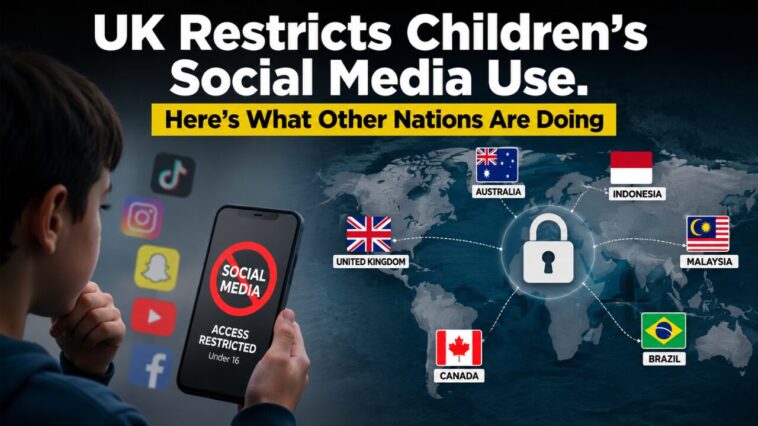
The UK is restricting children’s social media use, joining a growing list of countries introducing age-based limits on platforms — this piece compares the UK’s approach to similar restrictions being rolled out elsewhere.
The British government has announced that children under the age of 16 will no longer have access to several social media platforms, such as TikTok, Snapchat, and YouTube.

According to the ministers, the plan is to protect the children. It seems that the ministers are concerned that children are spending too long online and that they are stumbling upon dangerous content.
The proposal is an effort to keep Britain up to speed with several other countries that are introducing restrictions for children to access social media.
Not every country has taken the same measures, as other countries have fully banned social media and some have enforced age checks and parental controls.
Australia
Australia made headlines when it introduced its social media law last December.
The rules prevent children under 16 from holding accounts on
- TikTok
- Snapchat
- YouTube
- X
- Threads
- Twitch
- Kick.
Companies that fail to remove underage accounts can face penalties worth millions of dollars.
Officials say action has already been taken on a large scale. According to government figures, almost five million accounts linked to children have been shut down since the law was introduced.
Read More: France Announces Social Media Ban for Children Under 15 by 2026
Indonesia
Indonesia announced its own restrictions in March.
The government said that online dangers for kids are increasing and cited cyberbullying, scams, porn, and social media addiction.
Because of this, users under the age of 16 are forbidden from creating accounts on TikTok, YouTube, Facebook, Instagram, Threads, X (formerly Twitter), Bigo Live, and Roblox.
Officials say the goal of the changes is to protect kids better online.
Malaysia
Malaysia has not introduced a complete ban. Instead, it wants social media companies to do a better job of checking users’ ages.
Platforms with at least eight million users in the country must stop children under 16 from opening accounts. The requirement affects services such as Facebook, Instagram, TikTok, and YouTube.
Companies that ignore the rules could face fines of up to 10 million ringgit.
Brazil
Brazil’s approach is slightly different.
Children under 16 can still use social media. However, their accounts must be linked to a parent or legal guardian.
The law took effect in March.
It also targets features that critics say encourage excessive use. Infinite scrolling and automatic video playback are among the tools affected.
The legislation also requires stronger age checks. Platforms can no longer rely only on a user claiming to be over a certain age.
Canada
Canada is looking at stricter protections for kids online as well.
Regulations introduced by the government would essentially create a new governing body, the Digital Safety Commission of Canada.
If harmful content is not removed, authorities would be able to block access for kids under 16 to that platform.
Self-harm, violence, hate speech, and non-consensual intimate content would fall into this category.
Read More: California Lawmaker Pushes a Four-Year Ban on AI Chatbots in Kids’ Toys
More Countries Are Looking at Restrictions
The debate is spreading beyond a handful of countries.
France, Spain, Denmark, Greece, Thailand, and South Korea are all examining ways to limit children’s access to social media.
Some proposals are still being discussed. Others are moving through the legislative process.
One thing is clear. Governments around the world are paying closer attention to how children use social media and what they encounter online.
Frequently Asked Questions
What restrictions is the UK putting on children’s social media use?
The UK has introduced new limits on how children can access and use social media platforms, joining a broader international trend toward age-based restrictions.
Which other countries are restricting kids’ social media use?
Several nations have introduced or proposed similar age-based limits, reflecting growing global concern about social media’s effect on children’s wellbeing.
Related reading
Last updated: August 2026.