Hajra Naz
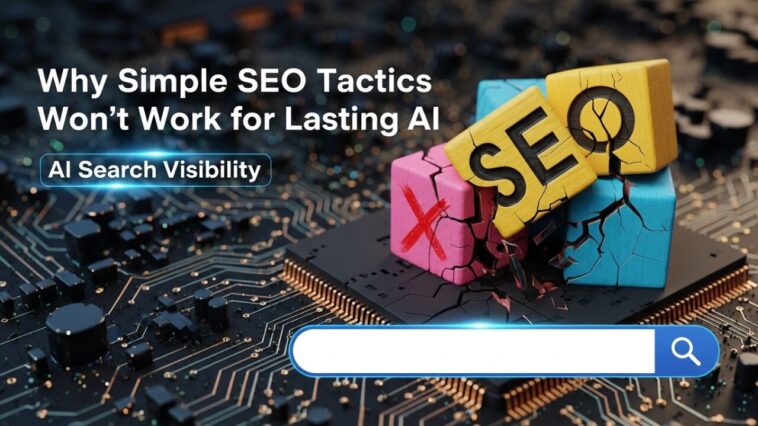
Basic SEO tactics like keyword stuffing and shallow content are losing their power as AI search tools favor knowledge graphs, expert entities, and trusted sources instead. Real visibility now depends on demonstrated authority, not simple on-page tricks.
Advice around AI search is becoming overly simplistic. Many marketers still focus on quick fixes and shallow tactics. But the real competitive edge comes from knowledge graphs, expert entities, and influence within trusted datasets.

A recent Harvard Business Review article highlights the broader shift in SEO: AI-powered features, including LLMs and Google’s AI Overviews, are not only creating a zero-click environment but also changing user behavior.
Multi-touch customer journeys are being compressed into single, synthesized answers, reducing the number of touchpoints brands once controlled.
In other words, the monolith of “Search” is crumbling, and marketers must rethink strategy. Algorithms now increasingly shape first impressions, meaning visibility is no longer just about ranking pages.
The Limits of Shallow Advice
While the HBR piece captures the trend, its tactical guidance is generic. Much of it defaults to familiar marketing playbooks that are easy to understand but lack operational depth. Surface-level advice may sound strategic, but it rarely ensures long-term visibility or sustainable results.
You may also like to read: How to Adapt Your SEO Strategy for AI-Powered Search
The Problem with “Flock Tactics”
HBR emphasizes schema, authorship signals, and branded concepts. These are what I call “flock tactics”: ideas that spread quickly because they’re easy to explain but offer little lasting competitive advantage once widely adopted.
Schema
Schema markup is widely discussed in AI optimization. Microsoft Bing confirmed its LLMs use schema, but Google and third-party models are more complex. Schema is important, but treating it as a silver bullet ignores diminishing returns. Once competitors implement similar markup, the advantage disappears.
External Knowledge Systems
AI models rely heavily on external authoritative sources, such as Wikidata or verified publishers. LLMs often prioritize these sources over individual websites. This nuance is critical but overlooked in most shallow SEO guidance.
Superficial E-E-A-T Signals
Adding author names, credentials, and bios follows E-E-A-T hygiene, but this is often cosmetic. Real trust signals come from creating genuine expert entities who are recognized in conferences, publications, standards committees, or academic collaborations.
A simple bio or headshot is far less powerful than a deeply embedded reputation that AI models recognize.
You may also like to read: How Generative Engine Optimization (GEO) Is Changing PR and Brand Visibility
Branded Concepts and Vanity Ideas
HBR also suggests creating branded frameworks, like “The Acme Index,” to associate ideas with a company. While appealing in theory, these rarely gain traction unless adopted by trusted datasets. To matter to AI models, concepts must appear in academic journals, technical standards, software ecosystems, or widely cited publications. Otherwise, branded labels remain invisible to the models.
Structural Blind Spots
Most guidance treats AI as an external platform shift—something you adapt to rather than actively shape.
Internalizing AI Infrastructure
Companies can embed AI in their own products through assistants, retrieval-augmented generation (RAG) systems, or domain-specific agents. These systems leverage first-party data and controlled interfaces, where traditional SEO concerns—site architecture, structured data, and product design—still matter but function differently than public search optimization.
Entity-Level Knowledge Management
SEO is no longer just about pages. Visibility now depends on how entities, taxonomies, and knowledge graphs are structured and how they connect to external authoritative sources. LLMs correlate strongly with trusted sources like Google, meaning effective entity management can influence broader AI visibility.
Model Heterogeneity
Different AI assistants and models have different datasets, refresh cycles, retrieval mechanisms, and safety layers. A single SEO tactic won’t work universally. Ignoring these differences risks hallucinations, attribution errors, or reputational damage.
You may also like to read: Study Shows AI Assistants Driving 56% of Search Queries Worldwide
The Bottom Line
Surface-level tactics—schema, superficial E-E-A-T, and branded concepts—are necessary but insufficient. Real visibility in the AI era requires the following:
Clear entity definitions
Structured knowledge systems
Reliable data in trusted datasets
Testing across different AI models and assistants
AI-powered experiences embedded within your products
Winning in the AI search era depends less on cosmetic SEO improvements and more on structural work behind the scenes.
FAQs
1. Why isn’t traditional SEO enough for AI search visibility?
Traditional SEO focuses on page rankings, but AI systems rely on entities, knowledge graphs, and trusted datasets, not just keywords.
2. What are “flock tactics”?
Flock tactics are easy-to-copy strategies like schema markup or superficial E-E-A-T signals that offer limited long-term advantage once widely adopted.
3. How can companies strengthen expert signals for AI?
Companies should cultivate real expert entities through publications, standards committees, conferences, and third-party recognition, not just author bios.
4. Why are branded frameworks often ineffective?
Branded concepts only influence AI models if they spread in trusted datasets outside your company, such as journals, software ecosystems, or widely cited publications.
5. How should brands approach AI search differently?
Brands must focus on entity-level knowledge management, structured data, model testing, and AI-powered experiences rather than relying solely on page-based SEO tactics.
FAQ
Why don’t simple SEO tactics work anymore?
AI-driven search increasingly pulls answers from sources it already recognizes as authoritative, so shallow, keyword-only content gets skipped even if it technically ranks.
What should replace basic SEO tactics?
Building topical depth and fixing technical foundations first. Many sites lose visibility simply from avoidable crawling errors before content quality even becomes a factor.
Related reading
- Google Stops Showing AI-Generated Overviews for Specific Medical Topics
- Google Ads Isn’t About Keywords Anymore: It’s About Intent
Last updated: August 2026.