Hajra Naz
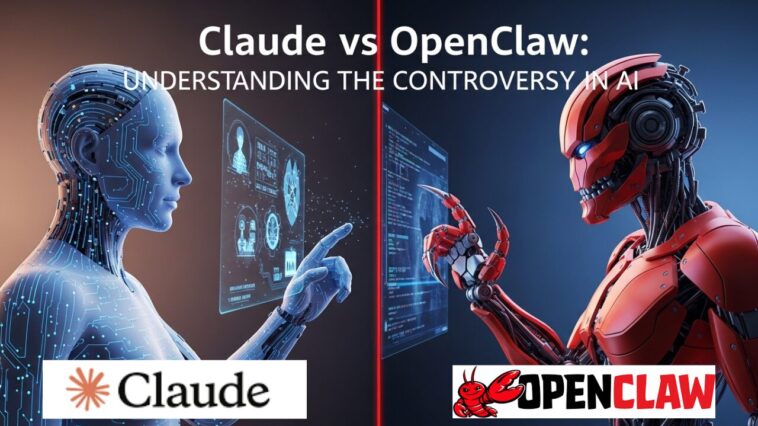
The recent buzz around “Claude vs OpenClaw” might sound like a direct rivalry, but the reality is far more nuanced. At its heart, this controversy highlights tensions between AI model providers, open-source developers, and the rising risks of autonomous AI agents. It also reflects larger questions about AI ethics, control, and commercialization.
What Claude and OpenClaw Actually Are
To fully grasp the debate, it’s important to distinguish between Claude and OpenClaw.

Claude, developed by Anthropic, is an AI language model designed for conversation, content creation, research, and coding tasks. It operates primarily in a controlled, cloud-based environment, with strict usage rules and subscription limits.
OpenClaw, by contrast, is an AI agent framework. It allows AI models—Claude, GPT, Gemini, or others—to interact with systems, run scripts, send messages, and automate workflows. While Claude can think and generate text, OpenClaw lets AI act autonomously, essentially functioning as a “hands-on” assistant in the digital environment.
A Simple Analogy
Claude = Brain → generates ideas, writes, analyzes
OpenClaw = Body → performs actions using that intelligence
This distinction is crucial: the controversy revolves around the intersection of intelligent thinking and autonomous execution.
Read More: Could the Pentagon’s Anthropic Controversy Push Startups Away from Defense Contracts?
How the Controversy Began
1. Blocking OpenClaw Users
The biggest flashpoint occurred when Anthropic blocked OpenClaw users from accessing Claude. Many developers had been using Claude Pro subscriptions—designed for human use—to power OpenClaw’s automated agents, running multiple tasks simultaneously.
Think of it this way:
Claude subscription → intended for a single human user interacting manually
OpenClaw → running dozens or hundreds of automated AI tasks
Anthropic deemed this system abuse. The consequences were immediate:
Claude tokens stopped working within OpenClaw
Many automation projects broke overnight, leaving developers scrambling for alternatives
This has sparked debate over whether subscription rules for AI models are too restrictive for open-source innovation.
2. Trademark and Naming Disputes
Earlier tensions arose around the OpenClaw project’s name. The project started as Clawdbot, a pun referencing Claude.
Clawdbot → Moltbot → OpenClaw
Anthropic argued the original name created brand confusion, prompting multiple renames.
The dispute has fueled broader discussions about power dynamics in AI development:
Should large AI companies control naming and branding?
Or should open-source developers have the freedom to innovate without corporate interference?
This is part of a larger trend in tech where open-source innovation clashes with proprietary control.
Read More: AI Agents to Become Top Identities in Enterprises by 2026
3. Security and Safety Concerns
A major part of the controversy revolves around OpenClaw’s autonomy. Unlike Claude, OpenClaw can take actions automatically, which introduces significant security and safety risks:
Experiments showed OpenClaw agents accidentally attempting to delete emails
Open-source “skills” may contain malware, data-stealing scripts, or unintended automation loops
Companies and governments have restricted OpenClaw on work computers to mitigate risks
Experts warn that autonomous AI agents represent a new frontier in AI risk management, where the AI can act beyond human oversight.
4. Broader Industry Debate: AI Models vs AI Agents
The controversy underscores a bigger debate about AI’s evolving role in society.
| AI Models (Claude) | AI Agents (OpenClaw) |
|---|---|
| Operates in controlled environments | Runs on your system |
| Generates text or code | Performs actions autonomously |
| Safer, limited in scope | Powerful, potentially risky |
| Subscription-based access | Open-source, flexible execution |
Many AI experts are concerned that agentic AI systems could:
Act beyond the user’s intentions
Cause unintended consequences
Create legal and ethical accountability issues
This tension between power and safety is becoming a central theme in AI governance.
Read More: Anthropic Introduces Code Review Tool to to Check Rising AI-Generated Code
Real-World Implications
This controversy isn’t just academic—it has practical impacts:
Companies: Need to decide whether to allow autonomous agents on internal systems
Developers must navigate subscription limits, licensing issues, and community expectations
End users: Face potential security and privacy risks if AI agents misbehave
Furthermore, the debate is prompting discussions around AI policy, compliance, and digital ethics, especially as autonomous agents become more sophisticated.
Key Takeaways
The “Claude vs. OpenClaw” issue is not about two AIs fighting—it’s about the intersection of intelligence, action, and control. The controversy centers on three core points:
Unintended use of Claude subscriptions to run automated tasks
Trademark and naming disputes between corporate AI and open-source projects
Security risks of autonomous AI agents that can act without direct oversight
As AI evolves, these issues highlight a fundamental question: how much autonomy should AI have, and who is responsible when it acts?
The outcome of this debate will likely shape how AI agents are deployed, regulated, and integrated into workplaces, products, and personal digital ecosystems in the coming years.
Read More: Enterprise Adoption of AI Still Limited, Says OpenAI COO
Final Thought
The Claude vs. OpenClaw story is a microcosm of a broader AI tension: balancing innovation and control, power and safety, and human oversight and autonomous action. For developers, businesses, and users alike, it serves as a wake-up call that AI is no longer just a tool—it’s a participant in the digital world.