in ,

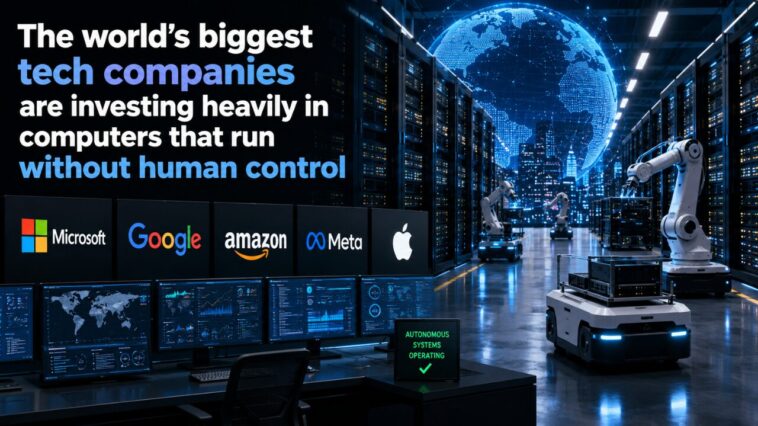
The world’s biggest tech companies are investing heavily in computers that run without human control

Big tech invests in self-running computers without control

New York. Tech firms have worked for over a decade on computers that handle complex work on behalf of users. Most attempts have not delivered strong results. Tools like Alexa and Siri still serve basic needs. Things like alarms and music control dominate use.

Big tech companies now expect a shift.

Hosting 75% off

Nvidia, Microsoft, Google, and others have rolled out new tools and hardware. These launches point toward systems that reduce reliance on keyboards and mice. New chips, laptops, and software appeared this week. The focus sits on AI agents that can complete multi-step work on their own.

“The goal eventually is to figure out, ‘Hey, how do I just tell the computer essentially what I want it to do, and then have it do it?’” said Bob O’Donnell, founder and chief analyst at Technalysis.

Microsoft and Nvidia are also reshaping Windows for this direction.

Nvidia introduced a new Windows laptop chip on June 1 called RTX Spark. The chip runs AI agents without a cloud connection. It combines graphics, compute, and networking parts. It also carries more memory than standard laptop chips. Dell, HP, and Lenovo plan to ship devices using it this fall.

Google is preparing Google Books. It will suggest actions based on cursor movement. A user may hover over a date in email. The system could then suggest setting up a meeting.

Nvidia CEO Jensen Huang delivers the keynote address during the Nvidia GTC on March 18, 2025, in San Jose, California.

Tech companies have chased digital helpers for years. Early systems handled small tasks. Things like online orders or travel bookings. They struggled with multi-step work and personal context. That started to shift after large language models grew popular after ChatGPT launched in late 2022.

OpenClaw, an AI assistant popular with developers this year, shows this change. It can run programs and complete tasks without constant input. Some developers run it on a home machine for research. They check progress later through WhatsApp or Telegram while doing other work.

Reports from Bloomberg and The Wall Street Journal say some employees now speak commands instead of typing.

“Things are quite different now because more people have now become quite used to using like ChatGPT or Gemini or Anthropic,” said David Naranjo of Counterpoint Research.

At a recent press event, Nvidia CEO Jensen Huang showed a laptop using new chips. The system helped design a house. AI agents moved between 3D design apps during the process.

Microsoft also introduced Scout for Microsoft 365 on Tuesday. It uses OpenClaw technology. Scout works across cloud files, local storage, and web content. It connects with Outlook and Teams. Microsoft aims for it to track emails and work messages in real time.

The logo of OpenClaw, an open-source AI assistant, is seen on the software's website on March 12, 2026.

Experts still expect slow adoption.

Cost remains a barrier. New laptops with these chips will likely stay expensive for many users. AI agents also evolve fast in software form, without needing new hardware.

“It’s not yet become indispensable, right? And I think that’s where the challenge exists for Nvidia and Microsoft and others,” said Naranjo.

AI already shows stronger value in business settings than personal use. Local processing can improve security. It can also reduce cloud costs for companies.

Trust remains another concern. An AI agent might misunderstand instructions. A wrong purchase or booking could create real problems.

“There’s a whole host of issues that need to be resolved before this becomes mass market,” said Jitesh Ubrani of IDC. “But are we on the right track? Yes.”

Hosting 75% off

Written by Hajra Naz

Instagram Officially Launches Premium Plus Subscription Service

Leaked dummy units reveal Apple’s first foldable iPhone design

Leaked dummy images give a clearer view of Apple’s upcoming foldable iPhone design