Hajra Naz
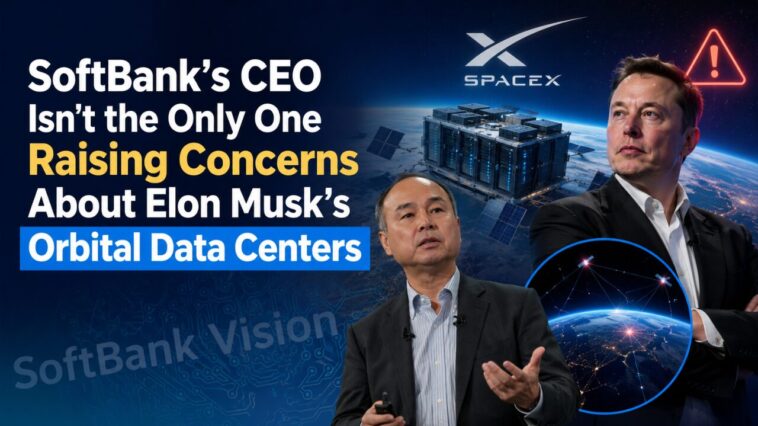
Elon Musk’s plan to build data centers in space is getting a lot of attention. Many people believe orbital data centers could help meet the growing demand for AI computing power. Others think the idea is still too ambitious and not practical.
One of the latest people to question the plan is SoftBank founder and CEO Masayoshi Son.

Speaking at a recent shareholder meeting, Son said he is not convinced that building data centers in orbit makes financial sense. He argued that the AI industry needs practical solutions now. Waiting another decade is not an option.
“In the battle for AI, the next few years will be far more important than what might happen a decade or so from now,” Son said.
His remarks have sparked fresh debate across the tech industry. Some experts see orbital data centers as the future of AI infrastructure. Others believe the technology is too expensive and too far away from becoming a reality.
Read More: The Next Big Computing Revolution Is Coming—And It’s Not AI
Why Masayoshi Son Is Skeptical
There is an overwhelming need for computing power brought on by the AI boom.
Everyone is scrambling to build out new data centers to train and deploy stronger AI models. Simultaneously, many projects remain uncompleted owing to scarce electricity and land scarcity, compounded by environmental rules and extended construction periods.
Various industry figures argue that relocating data centers into outer space would be able to ultimately sidestep many of these issues. There is no shortage of solar power in orbit, and large infrastructure projects are not held up by nearby communities objecting.
Son isn’t convinced.
He believes launching massive computing facilities into orbit would be extremely expensive. More importantly, they wouldn’t be ready in time to solve today’s AI infrastructure shortage.
For companies competing in artificial intelligence, waiting ten years simply isn’t an option.
TechCrunch Hosts Weigh In
The topic became a major discussion on the latest episode of TechCrunch’s Equity podcast.
The panel examined Son’s comments while also discussing OpenAI’s custom AI chips, Groq’s latest $650 million funding round, and the growing competition among AI infrastructure providers.
Kirsten Korosec, TechCrunch’s transportation editor, highlighted what she saw as an ironic turn of events.
Vision Fund, one of the most aggressive and risky projects in its history, has been around, investing in bold ideas for decades. Now, Son, despite that history, is one of the loudest voices asking questions about another massive tech project.
Just a few years ago, Korosec said, such promises about orbital data centers would have sounded ridiculous to many investors. More than one of the founders and venture capital companies has taken this idea seriously, even today.
A question in the public domain from someone with Son’s influence is, she argues, “better than waiting until the industry has really accepted that.”
SpaceX Could Benefit Either Way
TechCrunch senior reporter Sean O’Kane believes there is another side to Musk’s proposal.
Even if orbital data centers prove difficult to operate, they could still create significant business opportunities for SpaceX.
Launching thousands of satellites would require an enormous number of rocket launches. Those satellites would also have to be replaced every few years as technology improves or hardware reaches the end of its lifespan.
That creates continuous demand for SpaceX‘s launch services.
According to O’Kane, every new orbital data center satellite would generate additional launch business for Musk’s own company.
In other words, SpaceX could benefit not only from operating orbital computing infrastructure but also from repeatedly launching and replacing the hardware needed to keep it running.
SpaceX Is Already Expanding Its AI Business
SpaceX has already begun building an AI-related business beyond rocket launches.
The company is renting out high-performance computing capacity to outside organizations. It recently signed another agreement to lease AI compute resources following previous partnerships with major technology companies.
Industry analysts say selling compute has become an attractive business as AI developers struggle to access enough GPUs.
Several companies are entering this market.
Groq is rapidly expanding its AI infrastructure business after securing hundreds of millions of dollars in new funding. Cloud providers are also investing billions to meet growing enterprise demand.
The question, however, is whether these businesses remain profitable once the current AI capacity shortage begins to ease.
The Bigger Problem: AI Needs More Compute
The discussion highlights a larger challenge facing the AI industry.
Modern AI systems require enormous amounts of processing power.
Building traditional data centers has become increasingly difficult because of rising construction costs, limited power grids, permitting delays, and environmental concerns.
That pressure is encouraging companies to explore unconventional ideas.
Some are investing in nuclear-powered facilities. Others are building data centers closer to renewable energy sources. Musk’s proposal pushes that thinking even further by moving computing infrastructure into orbit.
Whether that vision succeeds remains uncertain.
Every Company Has Something to Gain.
Another point raised during the podcast is that nearly every executive discussing AI infrastructure has financial interests tied to their predictions.
If orbital data centers become a reality, SpaceX could dominate satellite launches and space-based infrastructure.
SoftBank, meanwhile, has invested heavily in large-scale data center projects on Earth. A future centered on terrestrial AI infrastructure would naturally support those investments.
OpenAI CEO Sam Altman has also expressed doubts about orbital data centers. While his concerns focus on practicality, OpenAI is investing billions in building massive AI data centers on Earth through projects like Stargate.
That doesn’t necessarily mean any of these leaders is wrong.
It simply means their opinions are shaped by the businesses they are building.
Orbital Data Centers Remain a Long-Term Bet
There is little disagreement that AI companies need more computing power dramatically.
What that infrastructure will look like and where it should be built: that is the real debate.
Advocates claim orbital data centers could one day solve power shortages, lessen land constraints, and generate effectively infinite solar energy.
Others point out that the engineering challenges, launch costs, maintenance requirements, and long time between concept and usable flight hardware make such an approach unworkable to address modern AI issues.
For now, the vision of Elon Musk is only that—a vision.
Whether orbital data centers become the future of AI infrastructure or remain one of the industry’s boldest ideas is a question that likely won’t be answered for many years.
FAQs
1. What are orbital data centers?
Orbital data centers are computing facilities placed in space using satellites or space platforms instead of being built on Earth.
2. Why is Masayoshi Son skeptical about orbital data centers?
Son believes they would take too long to build and wouldn’t help solve the AI industry’s immediate need for more computing power.
3. Why is Elon Musk interested in space-based data centers?
The idea could avoid land and power limitations on Earth while using abundant solar energy in space to run AI infrastructure.
4. How could SpaceX benefit from orbital data centers?
SpaceX could earn revenue by launching thousands of satellites, replacing aging hardware, and potentially providing AI computing services in orbit.
5. Are orbital data centers likely to become a reality soon?
Most experts believe the concept is still years away. Significant technical, financial, and engineering challenges must be solved before large-scale deployment becomes possible.