Hajra Naz
AI models have become significantly more powerful in recent years. As that power has grown, so has the risk of misuse. Along with that risk, there’s been a growing demand for real safety guardrails. Those guardrails need to actually stop abuse from happening. AI companies now face a genuine balancing act. They must respect enterprise customers’ privacy. At the same time, they need to watch for potential misuse.
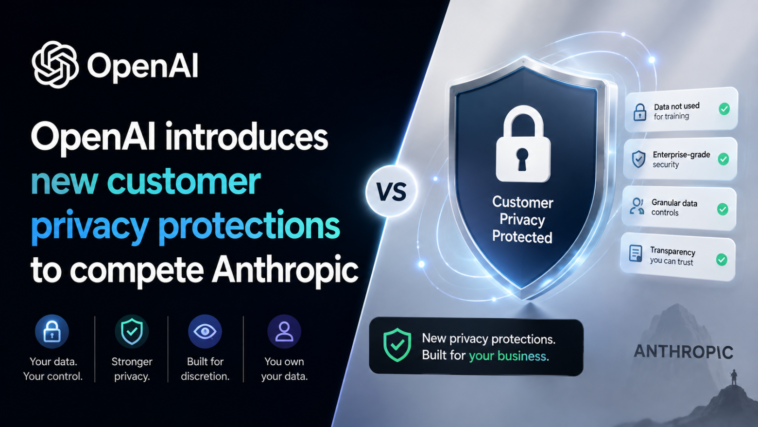
OpenAI just made a notable announcement. The move appears aimed at gaining an edge over rival Anthropic. OpenAI unveiled a privacy-centric approach to monitoring for misuse. The company is previewing this new service to select customers. It’s called Private Safety Processing. This is an automated system with a specific goal. It watches for potential abuse. At the same time, it retains none of the customer’s underlying data.

This approach runs directly counter to a policy Anthropic recently announced. That’s Anthropic’s data-retention policy. The policy has frustrated some customers already. Under this policy, Anthropic can keep user data for a set period. That includes all sessions and the conversations within them.
The retention period lasts 30 days. This applies specifically to what Anthropic calls “covered models.” Those models include all Mythos-class models. They also include any future models with similar capabilities, according to the company.
This policy was announced back in July. It was designed with safety in mind. It allows Anthropic to sift through and analyze potential impropriety. However, the policy has caused real concern among some enterprises. Many handle large volumes of sensitive data. These companies don’t want that data stored, or inspected, by the AI lab itself.
Read More: Anthropic Passes OpenAI in Quarterly Revenue for the First Time
OpenAI, like most other AI companies, already offers a baseline level of privacy. This comes through a policy known as Zero Data Retention, or ZDR. Under ZDR, automated agents monitor for abuse within the OpenAI API. This happens on a per-session basis.
Customer data isn’t retained under this system. Still, companies can scan for problematic activity. This happens without needing human intervention. It’s worth noting that Anthropic largely follows ZDR too. The exception applies specifically to covered models, like Fable.
OpenAI describes Private Safety Processing as something new. It expands the scope of what ZDR previously covered. The company calls it a form of long-horizon safety monitoring. This system assesses inputs and outputs across multiple conversations. That’s different from monitoring just one conversation alone. The monitoring is still conducted by an automated agent. If triggered, that agent catches relevant interactions. It then analyzes them across sessions. The goal is spotting signs of potential misuse.
This new technology helps OpenAI catch a specific type of threat. That’s malicious AI use spread across multiple sessions. A company spokesperson explained, “Consider a hypothetical bad actor.” They might be trying to engineer malware for a cyberattack.
Read More: AI Price War Escalates as OpenAI and Anthropic Cut Rates While DeepSeek Raises Them
Such a person may spread their requests across several sessions. This helps them avoid detection under normal monitoring. Private Safety Processing can analyze those multiple conversations together. It looks for signs of abuse. Importantly, this happens without human review of a user’s actual conversations.
There’s a specific process when the system gets triggered. It may send what OpenAI calls a “narrowly defined signal.” This signal warns OpenAI about a specific type of activity. Based on that signal, OpenAI can then make a decision. The company determines whether enforcement action is necessary.
If it is, OpenAI will reach out to the customer directly. This allows the company to gather more context. It also lets OpenAI work with the customer on resolving the issue. At that point, a customer may choose to share data with OpenAI. That choice remains entirely at the customer’s discretion, according to the spokesperson.
Anthropic’s approach differs in a key way. The company notes that human review of customer data can occur. However, this only happens through what it calls a “controlled access path.” That path involves a small set of approved reviewers. Every single review session gets logged carefully. According to Anthropic, each log is “tamper-proof.” Reviewers cannot suppress or modify these records, the company says.
Read More: Anthropic CEO Says AI Backlash Is Fundamentally a Crisis of Trust
The broader competitive landscape between these two companies remains tense right now. Both are actively looking for any edge over the other. A recent report highlighted a notable gap. OpenAI’s Q2 growth came in slower than Anthropic’s.
Anthropic’s annualized revenue run rate has grown substantially too. That figure now reportedly sits at $65 billion. Some Anthropic investors have floated an ambitious possibility. They’ve suggested the company could eventually IPO at a $2 trillion valuation. Meanwhile, OpenAI is working on its own IPO plans as well.