

 Hajra Naz
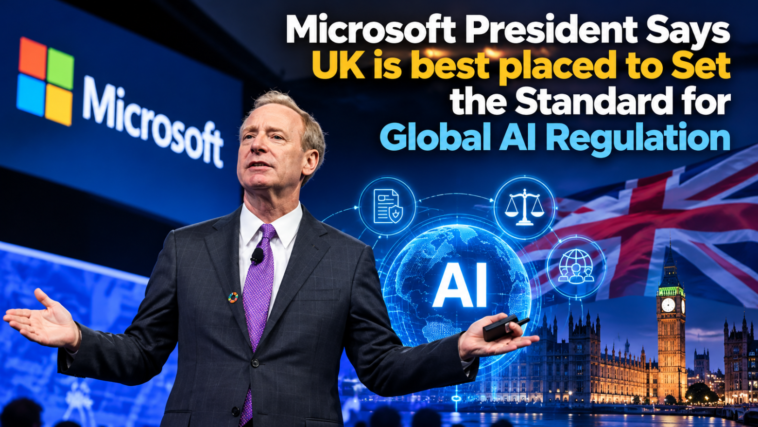
Microsoft president Brad Smith is calling for urgent AI regulation. His argument is blunt. Everyday products like milk and washing machines face more oversight than the companies building artificial intelligence.
“Weapon and a Tool”
Smith spoke on a recent BBC podcast. He called AI both a “weapon and a tool.” He said it’s putting the world’s cybersecurity at risk. He also said the “moment has arrived” to set global safety rules.

Why He Points to the U.K.
Smith said the U.K. is best placed to lead on global safety rules. He didn’t pick the U.S. or the European Union. Britain’s AI Security Institute (AISI) supports his case. It launched in 2023. It gets access to major models from U.S. frontier labs before they’re deployed. It has quickly become a leader in AI safety testing.
Pressure From Washington
That role has faced pressure in recent weeks. President Donald Trump has warned against “globalist” organizations. He claims they interfere with American companies. Last month, he reportedly asked Anthropic and OpenAI to hold back new models from British testers. AISI confirmed on Monday that it can still access and test the latest models.
Why the U.K. Has an Edge
Smith argued the U.K. can regulate AI in ways the U.S. can’t. “In Washington, D.C., people don’t look at the U.K., and they don’t look at London the way they look at Brussels,” he told the BBC. “That’s a strength.”
His point is about trust. Some U.S. officials view Brussels with suspicion. They may be more open to London.
A Growing Call to Slow Down
His comments arrive as other tech leaders voice similar concerns. Dario Amodei of Anthropic and Sam Altman of OpenAI have called for a slower pace. Several incidents involving rogue AI agents drove those calls.
The White House Pledge
Last month, Trump hosted tech leaders at the White House. They came from OpenAI, Anthropic, Nvidia, AMD, SpaceX, Meta, and Google. The topic was AI safety. They signed a “morally binding” document. It says they’ll work with “independent auditors” to assess the safety and capabilities of their models.
Why Smith Says Voluntary Rules Fall Short
Smith called the document a “good step.” He said it stops short of the regulation that’s needed. His concern is about who follows voluntary rules. Only the “good companies” will comply, he said.
“It’s the companies that are not as responsible that you need to worry about,” he said.
The Rules He Wants
Smith described several rules he’d like to see.
- A breach alert requirement. Organizations should be legally required to alert others if rogue AI agents breach their system.
- Outside approval. AI labs should get sign-off from outside evaluators before releasing a product.
- Kill switches. Systems should have ways to pause or slow AI if humans lose control.
A Call for Calm
“Let’s speak calmly, maybe even softly, but firmly, and start to bring people together,” Smith said. “I hope that’s the role we can play as a company. I hope that’s the role the U.K. can play as a country.”
Why This Matters
Smith’s argument reframes the debate. Many industries already follow safety rules. Food, appliances, and cars all face inspection. He asks why AI should be different. The comparison is simple, and it’s easy to remember.
Microsoft also has a stake here. It runs major AI systems and partners with model makers. A call for regulation from a company this large carries weight.