

 Hajra Naz
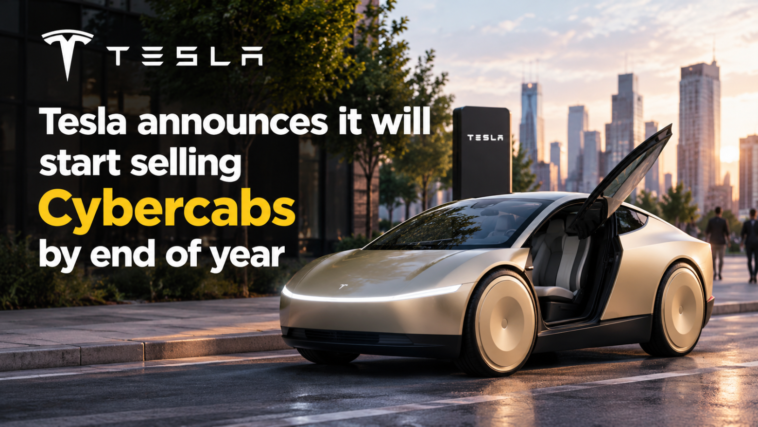
Tesla announced Wednesday that it plans to start selling its Cybercab to customers by the end of the year. This timeline comes even as federal regulators investigate whether the autonomous vehicle complies with official safety standards. The gold-toned, two-seater vehicle features no steering wheel or traditional manual driving controls.
Lars Moravy serves as the vice president of engineering at Tesla. During the company’s third-quarter earnings call, Moravy stated that Cybercabs currently coming off the production line are earmarked for Tesla’s internal robotaxi fleet. He explained that as the internal fleet expands, the company will begin delivering fully autonomous vehicles directly to retail customers.

Moravy noted that initial deliveries will start on a small scale. Tesla plans to expand operations gradually as it gains insights into vehicle delivery, customer ownership, and autonomous fleet management.
Tesla initially suggested selling autonomous vehicles to third-party buyers last month during its dedicated Cybercab event in Austin. The automaker even published an interest form online for prospective buyers interested in purchasing robotaxis. However, industry observers remained uncertain about how or if Tesla would execute those commercial sales plans.
Read More: Tesla reveals SpaceX-powered Roadster that flies with style
CEO Elon Musk has discussed building a massive network of affordable robotaxis for years. His original strategy relied on converting existing customer-owned Teslas into fully autonomous vehicles through over-the-air software updates. That specific vision has not yet materialized, and Musk’s recent remarks highlight a noticeable shift in strategy.
Tesla vehicle owners can currently subscribe to Full Self-Driving (supervised). This feature functions as an advanced driver-assistance package that automates routine driving tasks. However, the system still requires a human driver to supervise operations and intervene when necessary.
Tesla releases regular software updates to enhance the system’s capabilities. A human driver must remain attentive behind the wheel, despite numerous online videos showing drivers testing those safety boundaries.
Musk stated on Wednesday that an unsupervised version of Full Self-Driving will reach customers in the second quarter of next year. This announcement marks another timeline extension for Tesla owners, many of whom purchased or subscribed to the self-driving package years ago.
If Tesla meets both announced timelines, third-party commercial operators could buy the Cybercab and run autonomous taxi services before individual Tesla owners receive full self-driving capabilities on their personal vehicles.
Read More: One year later, Musk and Tesla Still Lack a Clear Meaning for “Abundance”
Musk clarified that the Cybercab is designed specifically for ride-hailing platforms rather than private consumer ownership. He explained that the Cybercab will operate primarily as a transport-as-a-service model, whereas consumer models like the Model 3, Model Y, and Roadster remain cars designed for personal ownership. He emphasized that the majority of Cybercab vehicles will be owned directly by Tesla and deployed within its corporate transit network.
Federal regulatory oversight could delay Tesla’s deployment timeline. The National Highway Traffic Safety Administration launched a formal investigation into the Cybercab last month, shortly after the vehicles began driving on public roads in Austin.
Federal Motor Vehicle Safety Standards mandate manual driving controls, including brake pedals and traditional rearview mirrors. Automakers typically self-certify that their vehicles meet these mandatory standards, which is the path Tesla pursued.
Read More: Tesla and SpaceX will invest $16.8B to build Terafab chip factory in Texas
Current safety regulations do not accommodate vehicles built without manual controls, though the Department of Transportation recently suggested updating rules for driverless designs. In the interim, federal regulators are auditing the technical data Tesla used to self-certify the Cybercab.
The outcome of that inquiry could determine whether Tesla and its prospective customers can legally operate the Cybercab on public roads.