Hisham Sarwar
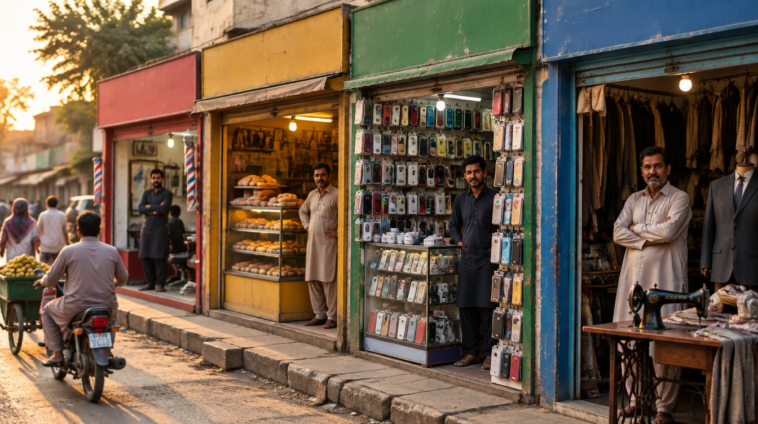
Pakistan has 229,120 business locations in the open mapping data, and 137,110 of them — 59.8% — have no website recorded at all. A further 1.4% list only a Facebook or Instagram page. Just 38.8% have a real site of their own. And 82.8% of all those businesses publish a phone number. That is the entire prospect list for anyone in Pakistan selling websites, landing pages, Google Business setup or local SEO, and it is larger than almost everyone assumes.
Where Pakistan sits against the rest of the world
The worldwide figure across 74,223,561 business locations in 259 countries is 42.6% with no website. Pakistan sits well above that, at 59.8%, in a band with its regional neighbours rather than with Europe.

| Country | Businesses | No website | No website % | Has phone |
|---|---|---|---|---|
| Thailand | 2,175,273 | 1,748,628 | 80.4% | 63.1% |
| Philippines | 1,158,723 | 880,583 | 76.0% | 68.1% |
| Indonesia | 2,045,515 | 1,497,094 | 73.2% | 68.0% |
| Vietnam | 1,610,044 | 998,918 | 62.0% | 86.0% |
| Pakistan | 229,120 | 137,110 | 59.8% | 82.8% |
| Bangladesh | 264,286 | 154,876 | 58.6% | 75.6% |
| India | 4,489,484 | 2,598,882 | 57.9% | 72.8% |
| United Kingdom | 3,207,987 | 690,670 | 21.5% | 87.6% |
| United States | 14,894,884 | 2,857,391 | 19.2% | 91.2% |
| Germany | 3,014,035 | 422,540 | 14.0% | 90.9% |
A high percentage is not a criticism of a country. It reflects how business is actually done. Where a customer finds a shop by walking past it, asking a cousin, or messaging a WhatsApp number from a signboard, a website earns its keep less obviously. What the number does tell you is that the density of unserved prospects in Pakistan is roughly four times what it is in Germany.
The phone column is the one that matters commercially. A business with no website and no contact number is not a prospect; you cannot reach it. A business with no website and a published phone number is a conversation you can have this afternoon. In Pakistan that is 82.8% of the list — a better contactable share than Thailand, Indonesia or the Philippines, which have higher no-website rates but are harder to actually reach.
Which trades are actually open
Geography sets the size of the pool. Trade decides how hard the sale is. These are worldwide figures by category, and the pattern holds in Pakistan as much as anywhere.
| Trade | No website % |
|---|---|
| Bar | 69.8% |
| Restaurant | 67.6% |
| Grocery store | 65.3% |
| Barber | 64.4% |
| Cafe | 62.0% |
| Beauty salon | 61.5% |
| Bakery | 53.6% |
| Clothing store | 49.6% |
| Mobile phone store | 48.3% |
| Automotive repair | 47.9% |
| Pharmacy | 42.5% |
| Gym | 41.4% |
| Dentist | 40.6% |
| Construction services | 27.9% |
| Doctor | 26.8% |
| Contractor | 18.6% |
| Financial service | 16.3% |
| Real estate agent | 15.0% |
Walk-in trades sit at the top. A barber, a bakery or a corner shop is found by being on the right street, and the owner has never had a concrete reason to buy a site. Considered-purchase trades sit at the bottom. When a customer compares three firms before spending real money — a contractor, an estate agent, a financial adviser — a website stopped being optional a decade ago.
That gives you a straight choice, and it is worth making it deliberately rather than by accident. The top of the table is where the volume is. The bottom is where the budgets are. Forty thousand barbers who have never bought a website is a different business from six thousand estate agents who all already have one and are unhappy with it.
The mistake most people make with this list
The instinct is to start at the top of the table, because the numbers are biggest. That is usually wrong for a beginner in Pakistan, for one reason: a barber with no website frequently does not want a website. He has no budget line for it, no idea what it would do, and no way to judge whether you did a good job. You are not competing with another developer. You are competing with the idea that the money is better spent on a new chair.
The easier first sale is a business that has already decided it needs to be online and has done it badly — a Facebook page as its only address, a phone number that goes nowhere, a site that loads in nine seconds on a mobile. That owner has already crossed the line you would otherwise have to talk them across. Worldwide, 1,149,821 businesses have nothing but a social page. Those are warmer than the empty rows.
The second mistake is contacting people the wrong way. Volume outreach into a cold list has rules, and they apply to a freelancer in Rawalpindi emailing a restaurant in Manchester exactly as much as they apply to a company with a sales team. We went through the practical version of that in the sending rules that apply below 5,000 emails a day. Read it before you send anything at scale, because getting your domain burned in week one is a genuinely expensive way to learn.
How to work the list without buying anything
You do not need a paid tool to start. The method is the same whether you do it by hand or with software:
- Pick one trade and one city. Not “businesses in Pakistan”. Barbers in Gulberg. Bakeries in Saddar. The pitch has to be specific enough that the owner believes you understand his business, and you cannot write that for a whole country at once.
- Filter for a phone number. A record with no way to reach it is not a lead. This alone removes about a fifth of the list.
- Look at what they already have. Social-only, broken site, slow site, or nothing. Each needs a different opening line. Sending the same message to all four is why most outreach gets ignored.
- Build one sample before you pitch, not after. A real page for a real business in that trade, that you can show in the first message. This is the single largest difference between freelancers who land local clients and freelancers who send 200 emails and get nothing.
- Price for the market you are selling into. A restaurant in Lahore and a restaurant in Leeds are the same amount of work and very different invoices. The data lets you choose which one you are chasing.
Where these numbers come from
Every figure on this page is from an open data study published by Frontage Leads, released under CC BY 4.0. It merges the Overture Maps Foundation release (CDLA-Permissive-2.0) with All The Places (CC0-1.0). Both are openly licensed and publicly downloadable. Nothing in it is scraped, bought from a data broker, or taken from Google Maps, and the records are business locations only — no personal contact data about individuals.
The study is the summary. The underlying list of 31,627,706 businesses with no website is searchable by country, city and trade with the phone number attached, and you can filter it down to businesses without websites in whichever market you want to sell into. The free tier gives ten exports without a card, which is enough to test whether a trade responds before you spend anything.
One honest caveat, which the study states itself: a missing website field means the open dataset has no site recorded, and occasionally a business has one that was simply never listed. Expect the true figure to be a few points lower than the headline in well-mapped countries. Pakistan is not a well-mapped country, so 59.8% is likely to be close to correct — but verify before you pitch, not after. Thirty seconds on Google saves you the embarrassment of telling a man he has no website while he is looking at his website.
Questions this raises
Is 229,120 really every business in Pakistan? No. It is every business location in the merged open dataset, which under-counts Pakistan considerably — informal and unregistered businesses are largely absent. The real number of businesses is far higher, and so, almost certainly, is the real number without websites. Treat 137,110 as a floor, not a ceiling.
Does a Facebook page count as a website? Not in this data. A record counts as social only when the sole address given is on facebook.com or instagram.com. Commercially they are the warmest prospects on the list, because the owner has already accepted that being findable online matters.
Should I sell to Pakistani businesses or foreign ones? Both are viable and they are different businesses. Local clients are easier to reach, easier to meet, and pay less. Foreign clients pay several times more and are harder to win without a portfolio. The usual path that works is local first to build samples and testimonials, then foreign once you have something to show.
Can I use these numbers in my own article or client deck? Yes. The source study is published under CC BY 4.0, which permits commercial use, provided you credit Frontage Leads and link to the study page.
Is any of this legal? Contacting a business on a phone number or address it has published is normal commercial behaviour in most markets. Bulk email is where the rules bite, and they differ by the recipient’s country rather than yours. Start with the sending-rules article linked above.