Hajra Naz
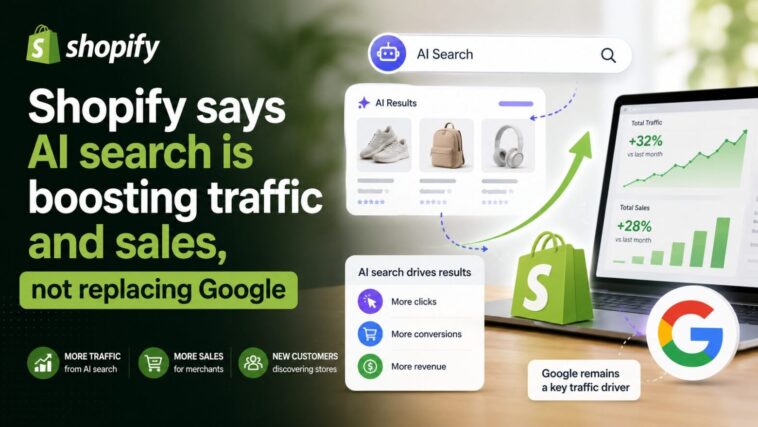
Shopify says AI-powered search (like ChatGPT and Google’s AI Overviews) is boosting its merchants’ traffic and sales rather than replacing traditional search, based on comments from President Harley Finkelstein on the company’s Q2 2026 earnings call.
Shopify appears to be a big winner from the rise of AI-powered search. The e-commerce software company shared strong results on its latest earnings call.

During the second-quarter earnings call, Shopify President Harley Finkelstein addressed this trend directly. He said AI has become a complement to traditional search, not a replacement for it. He noted this shift has especially helped the long tail of e-commerce. That includes the smaller merchants who make up most of Shopify’s customer base. In fact, the company credited part of its recent earnings beat and revenue growth directly to AI search.
This trend stands in sharp contrast to what’s happening in online publishing. There, AI summaries have caused a real drop in click-through rates. That drop has hurt traffic and, in turn, cut into advertising revenue for many publishers.
Shopify’s experience looks very different. The company sees AI as a genuine benefit to its business. It reported that AI-driven traffic and orders to Shopify stores nearly tripled year-over-year in the second quarter.
Importantly, this growth didn’t come at the expense of traditional search. Finkelstein was clear about that point. He told analysts that search remains one of the largest sources of buyer traffic for Shopify merchants. He added that traditional search is still growing too. Search sessions have increased 1.3 times over the past two years. They still account for roughly a third of all storefront sessions.
Read More: Speed Up Your Shopify Site: The Ultimate Performance Guide
The company’s overall numbers were strong. Revenue rose 36% year-over-year, reaching $3.6 billion. That beat Wall Street’s forecast of $3.4 billion. Gross operating profit climbed 31%, hitting $1.71 billion. That also came in ahead of analyst expectations of $1.63 billion.
Shopify went further, explaining exactly why AI search is working so well for its business. Finkelstein broke down the difference between traditional search and AI-driven search. He explained that search engines typically rank results based on popularity tied to a few keywords. AI agents work differently. They make multiple calls into Shopify’s product catalog. They also use richer, structured data to match products to a buyer’s actual intent, not just their keywords.
He gave a clear example to illustrate this. Imagine a buyer asks an AI assistant to find the best car seat that fits three across in a sedan. A traditional search engine would likely focus narrowly on the keyword “car seat.” An AI agent works differently. It understands the buyer’s real need. That includes exact dimensions, vehicle type, and the requirement of fitting three seats. The agent searches across all of these constraints simultaneously. The goal is to find a product that truly fits, not just one that ranks highest in search results.
In short, this deeper search capability is translating into better outcomes for merchants. AI is helping buyers find the right product faster and more accurately.
Finkelstein pointed to another key trend. Shopping journeys are getting shorter. About half of all AI-referred sessions now land directly on a product description page. That’s 2.5 times higher than what the company sees with traditional search.
There’s another notable pattern too. In the second quarter, 75% of AI-attributed purchases happened outside Shopify’s top 100 product categories. Finkelstein referred to those top categories as the company’s “sweet spot.”
Read More: How Shopify Can Help You Launch Your Online Store: A Comprehensive Guide
The company also sees another advantage on the horizon. As AI plays a bigger role in completing purchases, Shopify believes its trusted checkout experience puts it in a strong position to benefit.
Shopify isn’t just watching this trend from the sidelines, either. The company has been actively building connections with major AI tools and agents. That includes integrations with Claude, ChatGPT, Perplexity, Manus, Replit, and Vercel. Shopify has also connected with vibe-coding platforms like Lovable. These integrations let merchants build and customize their stores in whatever way suits them best.
Frequently Asked Questions
Is AI search hurting e-commerce traffic?
Not according to Shopify — the company reports AI-powered search is adding to traffic and sales for merchants, not cannibalizing it.
What does this mean for online sellers?
It suggests optimizing product listings and content for AI answer engines, not just traditional Google search, is becoming a real growth channel.
Related reading
Last updated: August 2026.