Hajra Naz
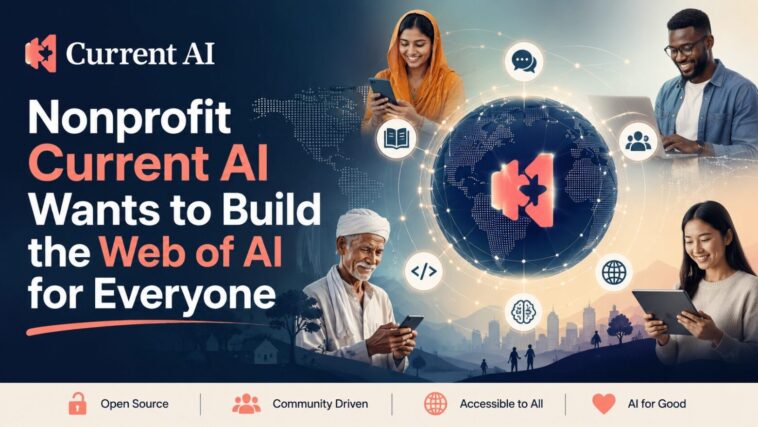
Imagine a farmer in a remote Indian village. Her crops are starting to die. She takes a photo of a damaged plant and wants to know what’s wrong. But there’s a problem. She doesn’t speak English. Most AI tools work best in English. Many also need an internet connection, which isn’t always available in rural areas.
Current AI, a nonprofit organization, wants to change that. It believes AI should work for everyone, not just English speakers or people with fast internet. Instead of building another commercial chatbot, the organization is creating open AI tools that anyone can use, improve, and share.

Bringing AI to Local Languages
At the India AI Summit earlier this year, Current AI partnered with Bhashini, the Indian government’s language AI initiative. Together, they introduced Suno Sutra, which means “listening chronicles” in Hindi.
Suno Sutra is a small offline device that runs AI in 22 Indian languages without needing an internet connection. This makes it useful for people living in rural areas where connectivity is limited.
According to Current AI CEO Ayah Bdeir, India has hundreds of languages and dialects, yet many are missing from today’s AI systems. She believes AI should reflect the diversity of the people who use it instead of serving only the world’s largest languages.
The project is also open source, allowing developers to build new applications and improve the technology for their own communities.
A Young Organization Moving Quickly
Current AI officially launched in February 2025, founded by Martin Tisne. Even though it is still a young nonprofit, it has already started funding projects around the world.
Last month, the organization awarded $3.2 million in grants to four different initiatives. More recently, it introduced Alpha Chat, an open-source AI chatbot, during the AI for Good Summit in Geneva.
The organization is growing rapidly while staying focused on public-interest AI rather than commercial products.
Leadership With AI and Education Experience
Ayah Bdeir became CEO in January after previously leading AI strategy at Mozilla.
She is also known as the founder of littleBits, a STEM education company that introduced millions of children to electronics and engineering before being acquired by Sphero in 2019.
Her experience in both education and technology now helps shape Current AI’s mission of making artificial intelligence more accessible worldwide.
Read More: OpenAI Launches New Voice Models for More Natural Conversations
Backed by Governments and Philanthropic Organizations
Current AI operates as a public-private partnership. Instead of relying on investors seeking profits, it receives funding from governments, nonprofit foundations, and technology organizations.
The French government provided an initial $100 million, while additional support came from organizations including the Ford Foundation, MacArthur Foundation, Google DeepMind, and Salesforce.
Together, these commitments have grown to approximately $400 million.
Bdeir says these organizations are funding public-interest technology rather than investing for financial returns.
Why Current AI Exists
Today’s most advanced AI systems are controlled by private companies such as OpenAI, Google, and Anthropic.
Current AI believes that if artificial intelligence becomes a technology used by everyone, there should also be an open public alternative that is freely available.
The organization compares its vision to the early days of the World Wide Web, where anyone could access information without depending on a single company.
Its goal is to build an AI infrastructure that communities can use, improve, and govern themselves.
Preserving Languages Through AI
Current AI argues that language is much more than communication.
Language carries traditions, history, identity, and cultural knowledge from one generation to the next. When AI cannot understand a language, it also struggles to understand the culture connected to it.
This concern is especially important because researchers estimate that nearly half of the world’s spoken languages are at risk of disappearing over time.
Bdeir says that because today’s largest AI models are trained mainly on English, many cultures and communities remain underrepresented.
A Different Approach From Big Tech
Many large technology companies have expanded support for multiple languages.
However, Bdeir believes their main goal is often to reach more users rather than protect local cultures.
She also raises concerns about how language data is collected. In some Indigenous communities, historical documents and translations may become AI training data before local people have agreed on how their cultural information should be used.
Current AI wants communities to have a stronger voice in deciding how their language and knowledge are included in AI systems.
Projects Across the World
Current AI’s first funding program supports organizations working in Africa, the Middle East, and South America.
One project led by Masakhane is creating AI datasets for more than 50 African languages to support healthcare, farming, and education.
In Lebanon, the Institute for Worldmaking is digitizing Arab cultural history into machine-readable databases while allowing communities to remain in control of the information.
Another initiative called Portal sem Porteiras is developing offline AI tools with Indigenous communities in the Brazilian Amazon. The goal is to keep sensitive data within local communities rather than sending it elsewhere.
Meanwhile, Kenya’s African Internet Rights Alliance is building tools that can audit AI systems and improve accountability across the continent.
Read More: Anthropic and Blackstone Launch New Company to Help Businesses Use AI
Keeping Communities in Control
One of Current AI’s biggest priorities is data ownership.
Bdeir believes local communities—not large technology companies—should decide how their information is collected and used.
To support that goal, the nonprofit encourages projects to store data locally whenever possible. Community experts are involved before development begins, and consent processes allow participants to stop projects if they no longer wish to continue.
Although no project has fully solved every challenge surrounding data governance, Current AI believes building community control into every project is an important first step.
Measuring Success Differently
Some people question whether a $3.2 million grant program can create meaningful change.
Bdeir argues that success should not be measured only by size or profit.
Instead, she points to the possibility of knowledge being shared across communities. For example, an Indigenous elder in the Brazilian Amazon could someday use an AI tool developed in Kenya to preserve and pass down ecological knowledge in their own language.
For Current AI, that type of impact is just as valuable as reaching millions of users.
Building an Open AI Ecosystem
Current AI is also developing the technology behind its projects.
Earlier this month, the organization introduced Alpha Chat, an open-source chatbot created in just seven weeks through a collaboration involving Hugging Face, Mozilla, MIT Media Lab, and several other partners.
Each organization contributed different parts of the system, including language models, safety tools, and computing resources.
Current AI has also partnered with Japanese startup Sakana AI to build an open-source AI stack designed to better support the Japanese language and culture while also benefiting underserved communities throughout the Global South.
Looking Ahead
Current AI is taking a different path from most AI companies.
We did not enter the competition in the next-generation commercial chatbot track and instead developed an open AI infrastructure that serves the various linguistic and cultural communities overlooked by mainstream AI.
While the prospects for the widespread adoption of this non-commercially oriented AI development model created by non-profit institutions remain to be observed, it has broken away from the logic that treats commercial success as the sole priority and adopts accessibility, openness, and community ownership as its core development principles.