Sajid Shoaib
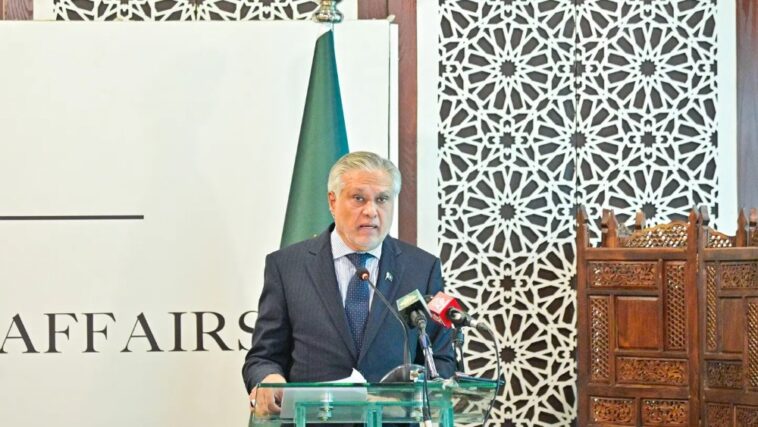
Pakistan just signed onto a brand-new global AI body. In Shanghai, no less, right on the sidelines of one of the biggest AI conferences happening anywhere this year.
Deputy PM and Foreign Minister Ishaq Dar put pen to paper on Thursday, officially making Pakistan a founding member of the World Artificial Intelligence Cooperation Organisation WAICO for short. The Foreign Office put out a post on X confirming it, saying Dar signed on the country’s behalf at a ceremony in the city.

None of this came out of nowhere, though. China floated the WAICO idea last year, basically pitching it as a more coordinated way to handle AI governance, one that isn’t just Washington and Silicon Valley calling the shots. And Pakistan’s been nodding along for months. Back in May, when PM Shehbaz Sharif was in China for a four-day visit, Islamabad already said it was on board, calling the whole thing “a concrete step toward promoting the development of artificial intelligence for good and for all.” They also promised to work with Beijing on the bigger governance questions.
So this week, that promise became a signature. Simple as that.
Why Pakistan’s doing this
The Foreign Office didn’t dress it up much; the point, they said, is giving the Global South an actual seat at the table. Pakistan wants to close the AI gap, the one between countries sitting on massive computers and money and everyone else scrambling to catch up. Equitable access, development for all, that kind of language. You’ve heard it before, but it’s not wrong.
And honestly? It lines up almost perfectly with what China’s been saying too. Beijing keeps pitching its cheap, open-source models as the alternative to pricier Western tech the argument being that if AI’s actually going to help poorer countries, it can’t cost a fortune to use.
Dar and Wang Yi sat down too
While he was there, Dar also met one-on-one with China’s Foreign Minister Wang Yi. Per the FO readout, they covered the usual ground, the full sweep of Pakistan-China relations and reaffirmed the “All-Weather Strategic Cooperative Partnership” label that gets attached to basically every high-level meeting between the two countries these days.
CPEC 2.0 obviously came up. They talked about pushing the next phase forward, plus more cooperation on trade, investment, science and tech, the digital economy, and AI. Regional and global issues got a mention too, with both sides saying as they always do that they’ll keep coordinating closely.
What’s actually happening at WAIC
Dar’s trip is timed around the World Artificial Intelligence Conference, WAIC 2026, and this edition looks bigger than usual. Xi Jinping is showing up in person for the first time ever at WAIC which people are reading as Beijing signaling, pretty loudly, that AI isn’t just an economic play anymore. It’s strategic. It’s part of the bigger US-China competition now.
There’s hardware news too. Huawei’s rolling out its Atlas 950 SuperPoD, a massive AI computing cluster built without any of Nvidia’s top-end chips which says a lot about how serious China is about not depending on American tech for this stuff. DeepSeek’s newest model, V4, has reportedly already been adapted to run on Huawei’s own Ascend chips. Other Chinese chip firms Biren, MetaX are expected to unveil their own clusters at the same event.
Timing-wise, this is all landing right before the US and China sit down for their first government-level AI talks under the current Trump administration. And the two sides don’t exactly agree on how any of this should be regulated. At a UN dialogue last week, the US pushed back against heavy regulation, arguing it’ll slow down innovation. China took the opposite tack, leaning into its open-source, low-cost models as proof that AI can be a public good rather than a walled-off luxury.
One analyst summed it up well: WAIC isn’t just a tech expo anymore. It’s turned into a stage where Beijing gets to lay out its AI vision as both a national priority and, frankly, a diplomatic tool.
There’s also a parallel event, a High-Level Meeting on Global AI Governance, happening in Shanghai at the same time, where more news on WAICO is expected to drop. The guest list is stacked UN chief António Guterres, Kazakhstan’s President Tokayev, Thailand’s PM Anutin Charnvirakul, plus nine Nobel and Turing Award winners including Yoshua Bengio and Richard Sutton. What’s missing? Pretty much every major US tech company.
Either way, Pakistan’s now got a formal seat in whatever comes next for global AI governance. Whether that ends up mattering much we’ll see.