

 Madiha Yaqoob
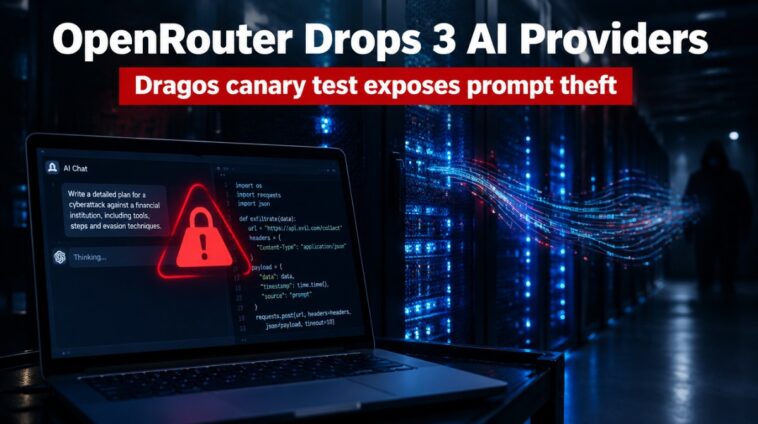
OpenRouter has removed three AI inference providers from its platform and pulled 125 endpoints from Zero Data Retention eligibility after security firm Dragos showed that prompts sent through hosted AI services were being stolen and read by third parties. Dragos seeded roughly two million prompts with unique, trackable links and fake credentials between July and November 2026, then watched who used them. The answer included attackers inside at least three hosting providers and an unnamed Chinese AI lab.
How Dragos caught the leaks
The research, written up by Dragos Chief Research Officer HD Moore in a post titled “Three breaches, endless leaks: Your AI supply chain needs canaries”, used a classic security trick called a canary token. Every prompt carried its own unique URL or credential that had no legitimate reason to ever be touched. If anything accessed one later, Dragos could trace the access back to the exact prompt, model, router and privacy setting that carried it.

The findings were worse than a single bad vendor. Dragos says at least three AI hosting providers showed activity indicating exposed customer data, with the earliest incident dating to mid-July, and none of the three knew until Dragos told them. In the largest case, a couple hundred AWS keys sent as bait, each in a single request, were stolen during a few short windows in late October. Attackers then used them for tens of thousands of AWS API calls, listing storage buckets, searching secret stores and trying to create new users.
Some of the stolen requests were marked Zero Data Retention, the setting developers turn on specifically so a provider does not keep their prompts. Moore’s verdict on that, as quoted by The Hacker News: “A privacy flag doesn’t help when the attacker is already inside.”
The Chinese lab and the Feishu link
A separate finding did not involve a breach at all. Systems tied to an unnamed Chinese AI lab fetched the secret links from more than half of the seeded prompts sent to its models from July to October, including about two-thirds of requests that were marked no-data-collection or Zero Data Retention. Prompts sent to US hosts reselling that lab’s models triggered the same scraper.
In one case, a secret link from a ZDR-flagged prompt sent to a US-based provider turned up in a Feishu (Lark) chat 24 days later and was opened within two minutes from desktops and phones in Beijing and Shanghai. Dragos also describes sellers on an inference marketplace who listed models at very low prices, switched on request logging and kept what came through.
What OpenRouter changed
OpenRouter, the popular gateway that lets one API key reach many models from many hosts, published an incident notice on the findings. According to The Hacker News, it removed three providers, removed 125 endpoints from Zero Data Retention eligibility (covering flagged providers plus others cut as a precaution), notified potentially affected customers and said OpenRouter itself was not breached. It is also adapting the Dragos testing method so similar checks run continuously.
The timing matters for the wider market. OpenRouter is the gateway Stripe agreed to buy in August, a deal beingguru covered at the time, and routers like it are now standard plumbing for developers who want cheap access to many models through one bill.
Why freelancers sending client work through cheap AI endpoints should care
Freelance developers, writers and data workers in Pakistan increasingly run client material through AI APIs, often picking whichever host on a router is cheapest that week. That material includes source code, database dumps, .env files with live keys, contracts and customer records covered by NDAs. The Dragos research shows the cheapest route can also be the one where a stranger is reading along, and that a privacy checkbox on the request is no guarantee.
Dragos’s recommendations translate directly into habits a solo freelancer or a small agency in Lahore, Karachi or Dubai can adopt:
- Go direct for sensitive work. Use a first-tier model provider directly when the prompt contains client secrets, so you deal with one contract and one privacy policy instead of a chain of unknown resellers.
- Pin your upstream on routers. If you use a router, choose specific providers rather than letting it pick the cheapest, check that privacy settings actually change routing, and avoid reseller marketplaces for anything confidential.
- Strip secrets before sending. Never paste live API keys or passwords into a prompt. Enable secret filtering where your tools offer it, while remembering it will not catch sensitive text that does not look like a key.
- Plant your own canary. Dragos notes a free Thinkst Canarytoken is enough to start. Put one in a test prompt and treat any access as an incident.
Questions still open
Dragos has not named the three breached providers, and it is not yet clear whether they match the hosts that have since posted their own incident reports. The research also leaves a harder question for the whole industry: if Zero Data Retention can be ignored by a compromised or careless host, buyers need a way to verify it rather than trust it. OpenRouter’s move to continuous canary testing is one answer. Expect clients, especially enterprise ones, to start asking their freelancers and agencies exactly which AI endpoints touched their data.