Hajra Naz
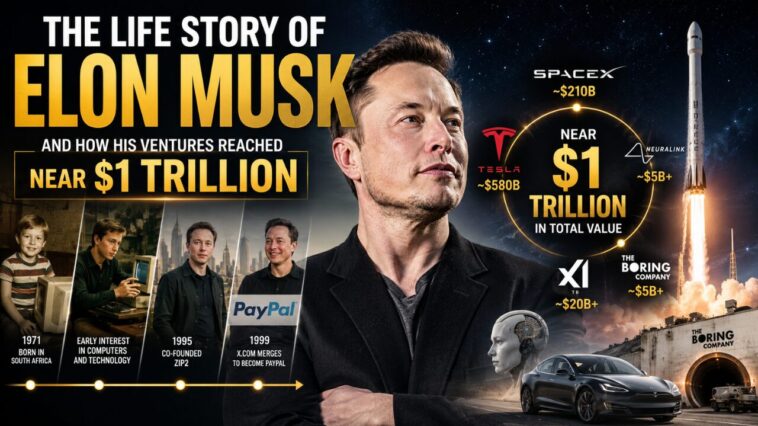
On Friday, June 12, 2026, global financial history was rewritten. Elon Musk became the world’s first trillionaire. This milestone followed SpaceX’s Nasdaq debut under the ticker SPCX at $150 per share. The company’s valuation crossed $2.1 trillion. His Tesla stake, worth about $300 billion, also added to his wealth. His net worth reached about $1.1 trillion.
His wealth now surpasses the GDP of countries like Taiwan, Ireland, and Sweden. It is also higher than the combined wealth of the next five richest people. This fortune did not build quickly. His path included hardship, public setbacks, and repeated financial risk.


1. The Early Years: An Isolated Childhood in South Africa
Elon Musk was born on June 28, 1971, in Pretoria, South Africa. His childhood was far from ideal. Following his parents’ painful divorce, Musk experienced a deeply strained and emotionally difficult relationship with his father, Errol Musk. At school, Elon was an introverted, bookish kid who found solace in science fiction and computers.
The Early Spark: At just 12 years old, Musk taught himself computer programming and wrote the code for a space-themed video game called Blastar, which he sold to a tech magazine for $500.
His school years were marked by severe bullying. In one terrifying incident, a group of boys threw him down a flight of stairs and beat him until he lost consciousness, leading to respiratory surgery later in life.
Desperate to escape this environment and avoid mandatory military service under the apartheid regime, Musk used his mother’s lineage to secure a Canadian passport. In 1989, at age 18, he arrived in Canada with just a backpack and a few hundred dollars, working low-paying manual labor jobs like cleaning boilers and shoveling grain.
2. The Silicon Valley Launchpad: Zip2 and the PayPal Coup
After transferring to the University of Pennsylvania to earn dual degrees in physics and economics, Musk moved to California in 1995 to pursue a PhD at Stanford University. He dropped out after just two days, realizing that the internet boom offered a once-in-a-lifetime opportunity to change human society.
The Struggles of Zip2 (1995–1999)
Alongside his brother Kimbal, Musk started Zip2, a company that provided online city guides and business directories to newspapers.
The Reality: They had no money for an apartment. They rented a tiny, cramped office in Palo Alto, slept on the office couch, and showered at the local YMCA.
The Grind: Musk coded tirelessly every single night. If the website was running during the day, he was fixing bugs at night.
The Payoff: In 1999, Compaq acquired Zip2 for $307 million. Musk walked away with his first major fortune: $22 million.
The Internal War at PayPal (1999–2002)
Instead of retiring, Musk plowed $12 million of his wealth into founding X.com, an ambitious online banking platform. X.com soon merged with its direct competitor, Confinity, which possessed a popular money-transfer service called PayPal.
Musk’s time as CEO was highly turbulent. He clashed aggressively with the board over technical architecture. In September 2000, while Musk was on a flight for a long-delayed honeymoon, the board executed a boardroom coup, ousting him as CEO and replacing him with Peter Thiel. Despite the humiliation, Musk kept his shares. When eBay bought PayPal for $1.5 billion in 2002, Musk netted $180 million.
3. The Brink of Ruin: The 2008 Double Crisis
With $180 million in the bank, Musk made the ultimate high-risk bet. He put $100 million into founding SpaceX (to make humanity multi-planetary) and $70 million into an early-stage electric vehicle startup called Tesla. He kept almost nothing for his personal expenses.

By 2008, Musk entered the darkest period of his life.
SpaceX Failures: The company’s first three rocket launches of the Falcon 1 failed to reach orbit. Musk was running out of capital to pay his engineers.
Tesla Disasters: The production of the original Tesla Roadster was plagued by massive delays and severe cost overruns. The global financial crisis hit, making venture capital dry up completely.
Personal Life: He was going through a highly publicized, painful divorce from his first wife, Justine.
Musk was forced to borrow money from friends just to pay his rent. He faced a brutal dilemma: split his remaining money between SpaceX and Tesla (which could mean both die), or choose one and let the other perish. He chose to fund both equally.
The Turning Point: On September 28, 2008, SpaceX’s fourth attempt—the final rocket they had money to build—successfully reached orbit. Weeks later, NASA awarded SpaceX a lifeline $1.6 billion contract. On Christmas Eve 2008, Tesla investors finally agreed to a funding round, saving the company hours before it would have declared bankruptcy.
4. Scaling the Empires: From Production Hell to Trillion-Dollar Valuations
Transforming Aerospace via SpaceX
Musk saw problems in the aerospace industry. Rockets were used only once. They were then discarded. Costs stayed extremely high.
- SpaceX built the Falcon 9. The rocket can land vertically. The first stage can be reused. This reduced mission costs by about 90 percent.
- Starlink became another project. It uses thousands of low Earth orbit satellites. It delivers internet across the world. Millions of users subscribe. It generates steady revenue.
The Nasdaq debut came in June 2026. Investors focused on SpaceX’s next goals. These include Starship development. It is the largest rocket ever built. The company also explores orbital AI data centers.
Read More: How the historic SpaceX IPO is creating overnight millionaires among employees
Defying the Odds with Tesla

In 2018, Musk faced another near-death experience during the production ramp-up of the Model 3, which he referred to as “production and logistics hell.” He slept on the factory floor in Fremont, California, personally fixing assembly line errors.
Global Dominance: Tesla eventually solved its manufacturing bottlenecks. Driven by the mass-market success of the Model 3 and Model Y, Tesla grew into the most valuable automotive company in the world, proving that electric vehicles could be highly profitable.
5. The Modern Era: X, xAI, and Geopolitical Influence
In October 2022, Musk acquired Twitter for $44 billion, later rebranding it as X. His ultimate vision is to transform it into an “everything app” combining social media, financial services, and media.
To combat the centralized monopoly of Silicon Valley AI companies, Musk founded xAI. He built the Colossus supercomputing clusters to train Grok, an AI assistant with real-time access to X’s data. In early 2026, xAI was formally consolidated into SpaceX’s corporate structure, significantly strengthening the company’s investor pitch by blending aerospace with cutting-edge artificial intelligence.
Musk’s influence has also expanded deeply into global politics. Following his substantial support for Donald Trump’s 2024 presidential campaign, Musk was appointed co-leader of the newly formed Department of Government Efficiency (DOGE), a federal advisory group that successfully cut $215 billion in government spending.
Summary of the Journey
| Era | Venture | Key Difficulties Faced | Core Strategic Breakthrough |
| 1995–1999 | Zip2 | Extreme poverty, sleeping in the office, grueling coding hours. | First major exit ($307M sale). |
| 1999–2002 | PayPal | Stripped of the CEO role during his own honeymoon. | Learned scaling; netted $180M from eBay sale. |
| 2002–2008 | SpaceX / Tesla | 3 consecutive rocket failures; total financial exhaustion in 2008. | Falcon 1 reached orbit and secured a NASA contract. |
| 2008–2020 | Mass Production | Model 3 “production hell”; slept on the factory floor to avoid bankruptcy. | Mastered rocket reusability; Model 3 became a global hit. |
| 2021–2026 | The Trillionaire Era | Extreme regulatory scrutiny; high-stakes Twitter buyout friction. | SpaceX Nasdaq IPO ($150/share) creates history. |
Elon Musk’s journey to becoming history’s first trillionaire is a masterclass in extreme risk tolerance, a relentless work ethic, and an absolute refusal to accept defeat. Where traditional investors looked for safe, incremental gains, Musk repeatedly risked his entire net worth on existential bets, ultimately reshaping the future of transportation, aerospace, and artificial intelligence.