Hajra Naz
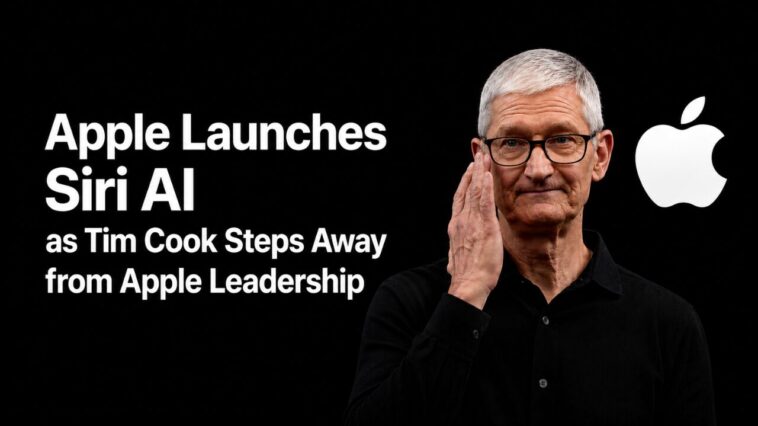
Apple used its Worldwide Developers Conference to introduce a major update to Siri, now branded as Siri AI. The company framed it as a step toward a more capable assistant that works across devices and apps with a more natural flow of interaction.
The announcement did not stand alone. Apple also laid out new trust and safety updates aimed at child protection across its ecosystem, arriving as part of its upcoming iOS 27 release.

WWDC 2026 carried extra attention for another reason. It marked Tim Cook’s final appearance at the event as Apple CEO before stepping down in September, closing a 15-year run at the top of the company. John Ternus, expected to take over, sat in the audience but did not appear on stage during the keynote.
Siri AI arrives after years of pressure in the AI race
Apple’s new Siri AI reflects a clear attempt to close the gap with rivals that moved faster into generative AI.
The updated assistant is designed to sit deeper inside Apple’s ecosystem. It connects more directly with apps, system tools, and services rather than acting as a separate voice layer.
Apple also plans a dedicated app experience for Siri AI, a structure that puts it closer to standalone AI assistants already offered by other tech companies.
The company says Siri will pull from past user interactions, understand images, and draw on wider contextual knowledge. The aim is a more flexible assistant that responds conversationally instead of sticking to fixed commands.
Craig Federighi, Apple’s software chief, took a subtle swipe at parts of the AI industry during his remarks. He questioned products built around AI features without a clear user need behind them.
He said Apple’s focus stays on usefulness and privacy. He also stressed that user data protection sits inside every layer of the new Siri system, not added afterward.
Read More: Apple approves Poke as the first AI agent inside Messages for Business platform
Apple Intelligence expands, but Siri rollout still lags
Apple Intelligence already includes writing tools and image features, but Siri has remained the slower-moving piece of the puzzle.
That gap has drawn attention. Competitors pushed ahead with rapid updates while Apple took more time refining its approach.
Analyst Ben Wood from CCS Insight said WWDC helped clarify Apple’s direction, though the real test comes later when users get access. He pointed to Apple’s emphasis on privacy and system-level integration as a strong position, but one that still needs proof in daily use.
Apple plans a beta release of Siri AI later this year for supported devices in English. The rollout will not include the European Union at launch.
The company said regulatory discussions in the EU did not reach a point where Siri AI could be introduced while still meeting requirements around third-party assistant access.
Apple also noted ongoing collaboration with Google. Its Foundation Models will include elements of Google’s Gemini systems and cloud infrastructure.
New safety tools target child protection concerns
Alongside AI updates, Apple introduced expanded safety controls tied to iOS 27.
One update strengthens parental approval systems. Parents will have more control over who their children can contact, with approval required for unknown users before conversations begin.
Another feature focuses on content filtering. Apple said its system will flag and block images it considers sexually explicit or violent from appearing on child-linked devices.
Craig Federighi said the tools aim to give parents clearer control over communication and content exposure without making the system harder to manage.
The changes come at a time when Apple continues to face criticism from child safety advocates.
Ahead of the keynote, a small group of protesters gathered near Apple Park. Among them, Sarah Gardner from the HEAT Initiative raised concerns about harmful content and so-called “nudification” apps.
She also called for stronger action against child sexual abuse material across cloud platforms and app stores, saying current protections do not go far enough.
Apple has previously said it removes apps that violate its rules and maintains active enforcement against harmful content.
In the UK, Prime Minister Sir Keir Starmer also urged major tech companies, including Apple and Google, to tighten restrictions on explicit content access for users under 18.
Read More: Leaked dummy images give a clearer view of Apple’s upcoming foldable iPhone design
Tim Cook closes his WWDC chapter
Tim Cook’s appearance at WWDC drew a different kind of attention this year.
He has led Apple for 15 years, taking over after Steve Jobs stepped down shortly before his death. Under his leadership, Apple expanded across hardware, services, and global markets.
At Apple Park, employees and developers gave him a standing ovation as he entered the keynote stage.
Cook opened with a light comment about the crowd, pointing out the number of iPhones in the room. The tone shifted later as he reflected on his time leading the company.
He thanked developers and Apple teams for their work and spoke about the impact of their products worldwide. He described the role as the honor of his lifetime.
John Ternus, his successor, remained off stage during the keynote but appeared at later briefings alongside Cook. He also attended a pre-event reception that drew attention as a possible introduction to his leadership role.
Some industry observers see WWDC 2026 as a transition moment for Apple, where hardware, software, and AI strategy begin to move more tightly together. If the rollout holds steady, Siri AI may sit closer to the center of that shift rather than the edge of it.