

 Hajra Naz
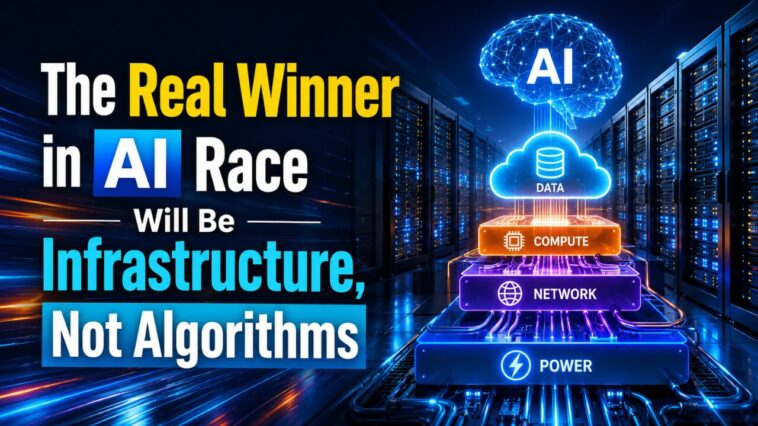
As the AI race accelerates, the real bottleneck and competitive edge won’t be algorithms — it will be infrastructure, since even the best models are limited by compute, energy, and data-center capacity.
Senior executives often point to familiar blockers when AI slows down. Talent gaps. Poor data quality. Regulatory pressure. Change management issues.

Those factors matter, but they do not sit at the center of the problem.
The real constraint sits lower in the stack, inside the infrastructure that carries the workloads.
Matthias Patzak, Executive in Residence at AWS and former CTO, points to two hard signals:
A large share of enterprise workloads still run on company-owned servers. At the same time, most global enterprises still depend on software that is more than two decades old.
That mix creates a structural limit. AI systems expect fast data access, elastic compute, and clean integration layers. Legacy environments were not designed for that kind of demand.
Patzak frames the situation as a turning point. Organizations that want AI at scale need modern data foundations and cleaner architecture. Waiting pushes them further behind.
AWS Transform and the Push to Modernize Enterprise Systems
Enterprise modernization has long been treated as a slow and risky process. Thousands of applications, complex dependencies, and fear of downtime keep many organizations locked in place.
AWS Transform changes that pattern by using agentic AI to support migration and modernization work across large environments. It handles systems such as Windows workloads, VMware environments, and mainframe applications, along with code and API transformation.
Tasks that once required weeks of manual mapping now run in a fraction of the time. Dependency analysis, workload assessment, and migration planning move from long human cycles to automated workflows supported by AI agents.
This shift compresses early migration phases and speeds up the full transformation pipeline.
According to AWS, organizations using AWS Transform report faster modernization cycles, with full-stack Windows application work accelerating multiple times over compared to traditional methods. Some migration programs have also cut overall timelines by nearly half.
Cost pressure drops alongside speed gains. Patzak notes that modernization efforts using AWS Transform have reduced transformation spend by a significant margin, freeing capital that previously stayed locked in system maintenance.
Security also improves during the transition. Cloud-based modernization reduces exposure from fragmented legacy systems and improves control over workloads. Reported outcomes include fewer security incidents and stronger baseline security posture after migration.
Thomson Reuters and the Shift From Legacy Limits to AI Readiness
Thomson Reuters provides a clear example of how infrastructure shapes AI outcomes.
The company managed hundreds of critical applications that were stable but difficult to evolve. Maintenance costs grew while innovation speed slowed.
Joel Hron, CTO of Thomson Reuters, describes the core issue as structural. Legacy systems were no longer just an IT concern. They directly affected how fast the business could move and what it could build.
AI ambitions added urgency. Building modern AI products on fragmented systems was not practical.
The modernization effort focused on rebuilding the foundation first. Using AWS Transform, teams moved away from slow manual migration approaches and adopted automated, parallel workflows for dependency mapping, code transformation, and workload planning.
The scale of change was significant. The company now modernizes around 1.5 million lines of code each month. Cloud operating costs have dropped by roughly 30 percent. Development cycles have also shortened.
Hron connects the outcome directly to AI readiness. Once the infrastructure layer improved, AI product development became practical at scale.
That foundation now supports CoCounsel, an AI system designed for professional use cases where accuracy and traceability matter.
BMW and the Pressure of AI-Driven Scale
BMW faced a different challenge. Its infrastructure was not outdated, but demand outpaced what even a strong on-premises setup could handle.
Connected vehicles, over-the-air updates, and AI-driven manufacturing created continuous pressure on systems built for a slower cycle.
Frank Uslaub, VP of Transformation at BMW Group IT, describes the issue as scale, not age. Traditional environments, including mainframe-based systems, struggled to match the speed and elasticity needed for modern digital operations.
AI added another layer. It increased demand for data availability while also becoming a tool for modernization itself.
BMW used cloud platforms and AI-assisted transformation to reduce the friction between ideas and deployment. Teams gained the ability to test, modernize, and scale services faster without long infrastructure lead times.
This shift supports continuous delivery across global operations. It also improves resilience in systems that support critical functions.
Uslaub notes that BMW is now building AI-based transformation as a long-term capability rather than a one-time project. That approach places ongoing modernization at the core of its operating model.
The Real Inflection Point for Enterprise AI
Across industries, a consistent pattern appears.
AI progress slows when infrastructure stays static. It accelerates when the foundation moves to modern, scalable systems.
The gap is not just technical. It shapes cost structure, delivery speed, security posture, and the ability to launch AI products that work in real environments.
Joel Hron highlights a common mistake. Many organizations treat modernization as a cost line rather than a strategic move. That view keeps legacy systems in place longer than they should stay.
The outcome is friction. Innovation slows. Maintenance costs rise. AI adoption becomes harder than expected.
Organizations that shift early reduce that friction. They also gain more room to build AI systems that operate at scale, not in isolated pilots.
The direction is clear. AI leadership depends less on model design and more on the infrastructure that supports it.
Frequently Asked Questions
Why does infrastructure matter more than algorithms in AI?
Even the best-designed AI models are ultimately constrained by compute power, energy availability, and data-center capacity — infrastructure sets the ceiling on what algorithms can actually achieve.
What counts as AI infrastructure?
Data centers, chips (like GPUs), energy supply, and the networking that connects them — the physical and computational backbone that makes running large AI models possible at scale.
Related reading
Last updated: August 2026.