Hajra Naz
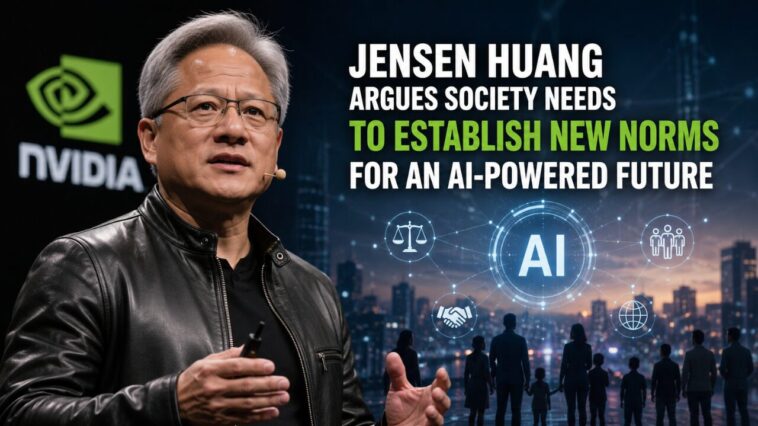
Nvidia CEO Jensen Huang argues society needs new norms for an AI-powered future, saying wider AI adoption could improve daily life but requires people and institutions to adapt how they work and think.
SHERMAN, Texas — Nvidia CEO Jensen Huang believes society needs to change as AI becomes a bigger part of daily life. Speaking to the Associated Press on Tuesday, he said wider use of AI could improve people’s lives and create new opportunities across the economy.

Huang has long been positive about artificial intelligence. He believes the technology can boost economic growth, speed up scientific discoveries, and help people work more efficiently. But as the head of Nvidia, a company that supplies many of the chips used in AI systems, he is also facing questions about the technology’s risks.
Many critics worry that AI could replace jobs, increase inequality, and create serious problems in the future. Huang understands those concerns. However, he does not believe people should push back against AI. Instead, he says society should learn how to adapt to it.
Read More: The Story of Jensen Huang, Nvidia’s founder and CEO
AI Has Become a Political and Social Flashpoint
Huang made his remarks at a time when artificial intelligence is becoming increasingly controversial in public and political discussions.
Across the United States, communities have raised objections to the rapid construction of data centers needed to power AI systems. At the same time, workers and labor groups have expressed concerns that businesses may use AI to automate jobs faster than displaced employees can find new opportunities.
These fears come as the United States finds itself in an intensifying competition with China over AI leadership. Huang believes America’s success in that race depends on remaining open to innovation and global competition.
His close relationship with President Donald Trump has also drawn criticism from some Democrats. Nevertheless, Huang insists that AI-generated computing power can help create manufacturing and industrial jobs that politicians have promised for decades but often struggled to deliver.
The 63-year-old executive, who describes himself as a relatively “boring” person because his life revolves around work and family, also shared a few personal insights during the interview.
He revealed that his favorite film is Kingdom of Heaven, the 2005 historical epic centered on the Crusader Kingdom of Jerusalem. Huang also said he has watched the science-fiction film Project Hail Mary three or four times and expects to watch it again soon.
Huang Believes AI Can Narrow America’s Technology Gap
Huang says one of AI’s biggest benefits is that it makes advanced technology easier to use. People no longer need deep technical knowledge to complete many tasks.
He pointed to AI tools that can build websites, review complex documents, support scientific research, and even help plan a kitchen remodel. He said these tools are breaking down barriers that once made technology difficult for many people.
In the past, tasks like these often required coding skills or software experience. Today, people can ask AI questions in everyday language and get help.
Because of this, Huang believes AI is helping more people access technology. He says it is narrowing the gap between experts and everyday users.
Read More: Jensen Huang Says Nvidia Is Stepping Back From OpenAI and Anthropic
Government Oversight and Safety Standards Are Necessary
Although Huang strongly supports AI adoption, he does not believe the industry should operate without oversight.
He argued that governments should establish appropriate regulations and safety standards while ensuring that national security remains a central consideration.
Artificial intelligence has played an increasingly important role in boosting stock markets and contributing to economic growth in recent years. As the technology becomes more influential, Huang said policymakers must balance innovation with responsible safeguards.
At the same time, he believes society will naturally adapt to AI in the same way it adapted to other transformative technologies.
Huang compared the current AI debate to the early days of automobiles. Cars were once viewed as dangerous machines that endangered children and disrupted communities. Over time, societies developed new systems such as sidewalks, traffic rules, and crosswalks to address those risks.
In his view, AI will follow a similar path.
Huang Questions the Value of Government Ownership in AI Companies
Nvidia’s meteoric rise has made it one of the most valuable companies in the world, with a market capitalization approaching $5 trillion.
Meanwhile, major AI developers such as OpenAI and Anthropic could eventually surpass the $1 trillion valuation mark once they become publicly traded companies.
The enormous wealth generated by AI has reignited concerns about economic inequality. Some policymakers have suggested that governments should hold ownership stakes in AI companies so that future gains could be distributed more broadly among the public.
President Trump recently floated the possibility of the U.S. government owning shares in AI firms. Similar ideas have been discussed by Senator Bernie Sanders and OpenAI CEO Sam Altman.
Huang expressed doubts about the proposal, saying he does not fully understand what problem government ownership would solve.
“I’m not exactly sure what they’re trying to achieve,” Huang said. “I haven’t had a dialogue with them about that.”
He emphasized that Americans already benefit from the success of domestic companies in numerous ways.
“These are American companies,” Huang said. “Their success benefits the stock price, of which many Americans are investors in. It generates taxes, which helps many Americans. It creates a lot of jobs.”
Huang also pointed out that the AI boom creates opportunities for industries beyond technology, including construction, energy, and hardware manufacturing.
“Americans have a stake in American companies already, naturally, in a whole lot of different ways,” he added.
National Security Must Remain a Top Priority
The Trump administration has recently adopted a more active approach toward AI oversight after initially favoring a lighter regulatory touch.
Among its recent actions were export restrictions on Anthropic’s newest AI models. The company subsequently suspended public access to those models, citing security concerns. Trump also signed an executive order encouraging voluntary government review of advanced AI systems before their release.
Huang said national security concerns deserve serious attention, but policymakers should clearly define the specific risks they aim to address.
“National security should always be the top concern of all technologies,” Huang said. “But having said that, you have to be very specific about the risk that you’re concerned about before setting up policies for export controls.”
During the Biden administration, Nvidia opposed export restrictions designed to limit advanced chip sales to China. Huang argued at the time that such measures could undermine America’s ability to shape the global AI ecosystem.
He warned that China would likely respond by accelerating development of its own advanced semiconductor technology, potentially weakening the effectiveness of U.S. restrictions.
Read More: Trump Says ‘No One Gets Nvidia’s Most Advanced Chips,’ But Huang Warns China Will Win The AI Race
Energy Supply Is America’s Biggest AI Challenge
Huang believes one of the greatest obstacles facing America’s AI ambitions is energy production.
Modern AI systems require massive amounts of computing power, and the data centers supporting those systems consume enormous quantities of electricity. As AI adoption accelerates, energy demand is expected to grow substantially.
Some future facilities may generate their own power, but Huang argued that the United States is already operating from a position of weakness when it comes to energy infrastructure.
Without significantly increasing energy production, he said, America may struggle to maintain its advantages in AI infrastructure, semiconductor development, and advanced AI models.
“The United States is woefully behind in energy production,” Huang said. “We just suffocated energy production for too long.”
Huang praised President Trump’s efforts to expand domestic energy production. The administration has strongly supported oil, coal, and natural gas development while showing far less enthusiasm for renewable energy sources such as wind and solar.
Although Huang did not directly address the debate surrounding climate-friendly energy alternatives, he acknowledged that growing electricity demand from AI contributes to public concerns about rising utility costs.
He delivered his remarks during a visit to Sherman, Texas, where Coherent is expanding a manufacturing facility that produces lasers used to transfer data between computer chips. The technology could potentially reduce AI-related power consumption by as much as 50%.
How Jensen Huang’s Relationship With Trump Began
Despite Trump’s limited background in technology, the president quickly developed a strong rapport with Huang.
Trump has publicly described the Nvidia CEO as “smart” and “amazing,” and has frequently included him in discussions about technology, manufacturing, and national competitiveness.
Their relationship began last year when Trump invited Huang to dinner at Mar-a-Lago, his private club and residence in Florida.
At the time, Huang was visiting the area to receive the Edison Achievement Award for his contributions to artificial intelligence.
“He said drop by for dinner, and so I did,” Huang recalled. He attended with his wife, Lori.
According to Huang, Trump immediately impressed him with his curiosity and engagement.
“He was incredibly engaging, incredibly charismatic, conversational, and asked a lot of questions,” Huang said.
Huang added that from their first meeting onward, Trump consistently focused on a handful of priorities.
“From the moment that I met him, the only thing that he’s ever talked to me about is creating more jobs, reindustrializing the United States, protecting national security, and winning,” Huang said.
The Nvidia chief also joked that Trump sometimes contacts him late at night to discuss those same topics.
Read More: The world’s biggest tech companies are investing heavily in computers that run without human control
Political Criticism Has Followed the Relationship
Huang’s proximity to Trump has not gone unnoticed by political opponents.
Some Democratic lawmakers have criticized the Nvidia executive for maintaining close ties to the president while declining certain opportunities to testify before Congress.
Senator Elizabeth Warren publicly questioned why Huang could attend an expensive fundraising dinner at Mar-a-Lago while not appearing before a Senate committee.
Despite the criticism, Huang said he wants elected leaders from both political parties to succeed because their success ultimately benefits the country.
“We could differ with politics, but we should want him to succeed,” Huang said. “Because when President Trump succeeds, our country succeeds.”
Debates over artificial intelligence continue to grow. But Huang remains confident that AI will become a normal part of everyday life. He acknowledges that the technology brings challenges and concerns.
However, he believes the answer is not to resist AI. Instead, society should adapt to it. That includes creating new expectations, regulations, and institutions that can keep pace with rapid technological change.
Frequently Asked Questions
What does Jensen Huang say society needs to do about AI?
He argues society needs to establish new norms and adapt institutions as AI becomes a bigger part of daily life, rather than resisting the shift.
Is Nvidia’s CEO optimistic about AI’s impact?
Yes — Huang has consistently framed AI as a tool that can improve people’s lives when society adapts its norms and practices around it.
Related reading
Last updated: August 2026.