Hajra Naz
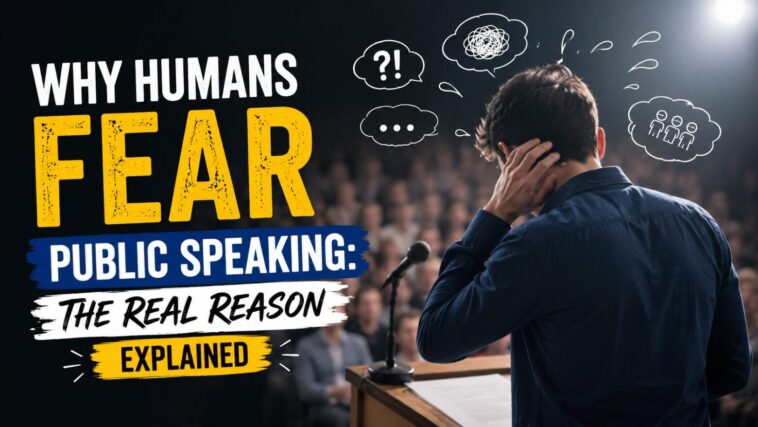
People fear public speaking not because of real danger, but because standing in front of a group triggers the same threat response our brains use for physical danger, making preparation and practice the real fix, not willpower.
Picture this: a man steps up to a podium. His shirt is damp, his hands won’t stay still, and the second he opens his mouth, his mind goes completely blank. Nobody in that room is holding a weapon. Nobody has threatened him. Yet his body is behaving as if his life were on the line.

This isn’t a rare, isolated reaction. It’s one of the most common experiences a human being can have—and understanding why it happens is the first step to making it stop controlling you.
You’re Not Alone. Not Even Close.
If you’ve ever frozen mid-sentence in front of a room or felt your pulse spike before a meeting where you had to speak, you’re in the majority, not the minority.
Roughly 75% of people experience some degree of anxiety around public speaking, while only about 10% genuinely enjoy it. That means for every person calmly commanding a room, there are seven others quietly dreading their turn.
This is worth sitting with for a moment. Fear of public speaking isn’t a personality flaw or a sign that someone is “not cut out” for leadership. It’s the default human response. The people who look comfortable on stage aren’t a different species — they’ve simply learned to manage a reaction that everyone else is also fighting.
Read More: Public Speaking “Skill” Is Now The Most Important Key To Your Success
It Beats the Fear of Death
Here’s a fact that sounds almost absurd until you actually think about it: surveys on common fears have repeatedly found that public speaking ranks above death itself on people’s list of worst fears—ahead of spiders, ahead of heights, ahead of the end of life as we know it.
Comedian Jerry Seinfeld once joked that this means, at a funeral, most people would rather be in the casket than delivering the eulogy. It’s funny because it’s true — and it tells us something important. This fear isn’t rational. It isn’t proportional to the actual danger involved. Which means the solution isn’t “just calm down” — it’s understanding where the fear actually comes from.
It’s Not Weakness. It’s survival wiring.
To understand why a room full of polite, non-threatening people can trigger a full-blown stress response, you have to go back tens of thousands of years—long before microphones, slides, or boardrooms existed.
In early human history, survival depended entirely on the group. A person who was rejected by their tribe wasn’t just embarrassed — they lost access to food, protection, and safety. Being cast out often meant death. So the human brain evolved a very specific alarm system: the moment you sense potential group rejection or judgment, treat it as a survival-level threat.
Fast forward to today. Your brain hasn’t been updated. When you stand in front of colleagues, classmates, or strangers, your amygdala doesn’t know the difference between “these people might silently criticize my presentation” and “this tribe might exile me from the fire. ” It fires the same ancient alarm either way.
This reframe matters. The shaking hands and racing heart aren’t proof that something is wrong with you — they’re proof that a 200,000-year-old survival system is doing exactly what it was built to do, just in the wrong century.
Read More: 5 powerful public speaking tips you should develop to engage the crowd
What’s Actually Happening Inside Your Body
When that alarm goes off, it doesn’t just create a vague feeling of nervousness—it triggers a cascade of very specific, measurable physical reactions:
- Racing heart — Adrenaline floods your bloodstream, spiking your heart rate to prepare you for action.
- Trembling hands — The same adrenaline surge causes involuntary muscle activity, which shows up as shaking.
- Sweating — Your body treats the stress as a physical threat and cools itself preemptively, exactly as it would during real physical exertion.
- Dry mouth — Adrenaline redirects blood flow away from non-essential functions like saliva production.
- Blank or foggy mind — Under acute stress, blood flow shifts away from the prefrontal cortex (responsible for complex thought) toward more primitive brain regions built for fight-or-flight, which is why articulate people suddenly can’t find their words.
None of these symptoms is random. Each one is a textbook stress response, and each one made perfect sense for a human trying to escape a predator. They make far less sense when you’re simply trying to get through a quarterly update.
The Real Trigger Isn’t the Crowd
Here’s the part most people get wrong: it’s easy to assume the fear comes from the audience itself—the number of people, the size of the room, the unfamiliar faces. But dig a little deeper, and you’ll find the real source is rarely external. It’s internal.
The thoughts running through your head in that moment are usually some version of:
- What if I mess up?
- I’m not good enough for this.
- They’re judging me.
- What will they think of me afterward?
The crowd is just on the stage. The actual trigger is the anticipated judgment—the story you’re telling yourself about what other people are thinking. And because that story lives entirely in your own mind, it’s also something you can learn to interrupt and rewrite.
And It’s Quietly Costing You More Than You Think
This isn’t just an uncomfortable few minutes before a presentation—it has real, measurable consequences on careers and income.
People who consistently avoid speaking up in meetings, hold back their ideas, or stay quiet during discussions tend to become less visible over time. Visibility builds trust. Trust builds recognition. Recognition leads to promotion. Silence, on the other hand, quietly moves people down a different track: overlooked, then stuck.
The numbers back this up. Research on workplace communication has linked poor public speaking confidence to:
- Up to 10% lower pay compared to peers who communicate assertively
- 15% fewer promotions over the course of a career
In other words, this isn’t just a “soft skill.” It’s directly tied to how far you go professionally, whether you get a seat at the table, and whether your ideas are heard before someone else says the same thing and gets the credit.
Read More: Public Speaking: How Positive Body Language Can Help
Here’s the good news.
If public speaking anxiety were a fixed personality trait, this would be a discouraging article. It isn’t.
What separates the person shaking behind the podium from the person speaking with calm, open body language and clear thoughts isn’t natural talent — it’s practice, exposure, and a handful of learnable techniques. The transformation looks like this:
- Before: racing heart, blank mind, fear of judgment, avoids speaking up.
- After: Calm and confident, clear thoughts, respected and heard, opportunities open up.
The difference between the two isn’t who they are. It’s what they’ve trained.
Public speaking anxiety is not a character flaw, and it’s not a life sentence. It’s a habit your nervous system picked up somewhere along the way—and like any habit, it can be unlearned, one rep at a time. The fear that once helped your ancestors survive a hostile world doesn’t have to run your career in this one.
Frequently Asked Questions
Why is public speaking so scary if there’s no real danger?
The brain treats being watched and judged by a group as a social threat, triggering the same stress response as physical danger, even though nothing is actually threatening you.
Can you get over the fear of public speaking?
Yes — repeated practice and preparation retrain the brain’s threat response over time, which is why experienced speakers feel calmer even in high-stakes settings.
Related reading
Last updated: August 2026.